History
Introduction and Location
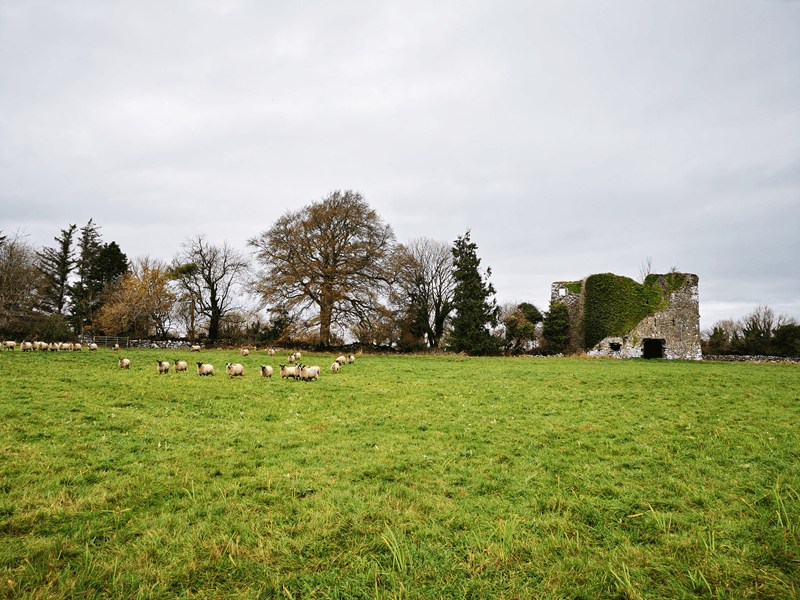
Moyne Castle stands beside the Black River, close to Headford, on the boundary between County Mayo and County Galway. Although the river marks the division between the two counties, the castle is recorded in County Mayo. Its location is identified in the Placenames Database of Ireland and documented by Irish Stones [1], [2].
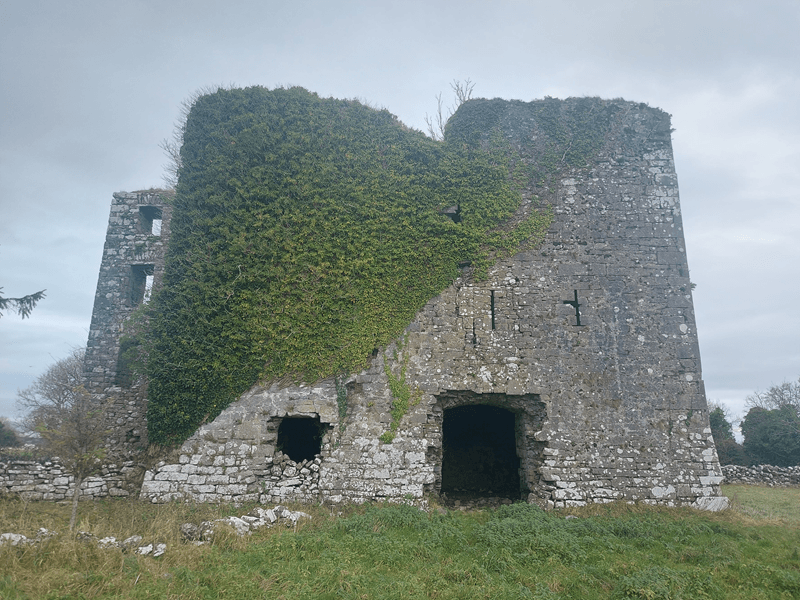
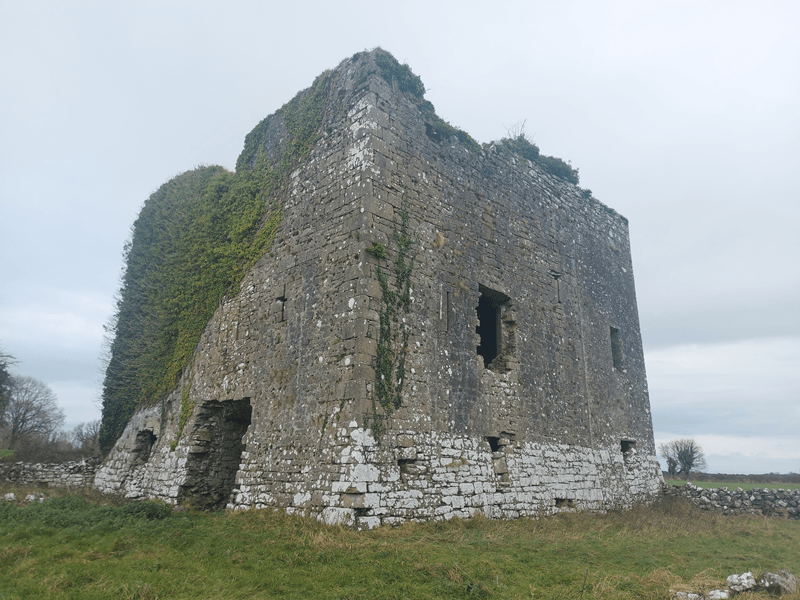
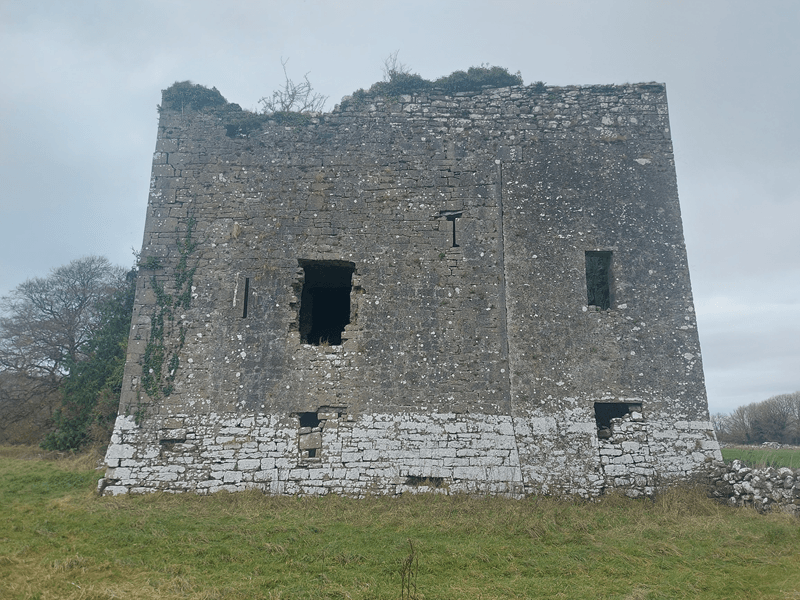
The castle is a medieval fortified site whose surviving remains include a substantial square tower and several adjoining structures. Although much of the building has fallen into ruin, its surviving layout still provides an indication of its original form and residential character.
Origins and Early History
The precise origins of Moyne Castle remain uncertain. In his study of Moyne Graveyard, archaeologist Conleth Manning describes the castle as a squat fifteenth-century tower house associated with the Burke family. Other accounts, however, generally date the surviving structure to the sixteenth century [2-4]. These descriptions may reflect different phases in the building's development, although the available evidence does not establish exactly when its various parts were constructed.
The Burkes, also known as the de Burghs, were among the most influential families in Connacht. Their control of land and strongholds was closely connected to the political rivalries that shaped the region during the late medieval and early modern periods.
The Dispute with the Earl of Clanricarde
Moyne became involved in a dispute in 1566 between the MacWilliam branch of the Burkes and the Earl of Clanricarde over control of the property. Manning's account indicates that Clanricarde appears to have prevailed, with Moyne subsequently granted to him in 1585 [3].
By 1574, however, the castle was recorded as belonging to David MacJonyn (Jennings) Blake. According to the available accounts, Ulick, Earl of Clanricarde, obtained the property through confiscation in 1585 [4]. This episode illustrates the complex and sometimes contested nature of landownership in Connacht during the period.
The Clanricarde and Blake Families
The connection between Moyne and the Clanricarde family continued into the seventeenth century. In 1610, Richard, Ulick's successor, received a new grant of the castle together with four quarters of land [4].
The property subsequently passed through different hands. Irish Stones records that George French occupied the castle in 1678, while in 1683 Thomas Blake obtained a lease from William, Earl of Clanricarde. The Blake family therefore re-established its association with Moyne and retained the property until 1731, when the family moved to Merlin Park, near Galway [2].
Architecture and Later History
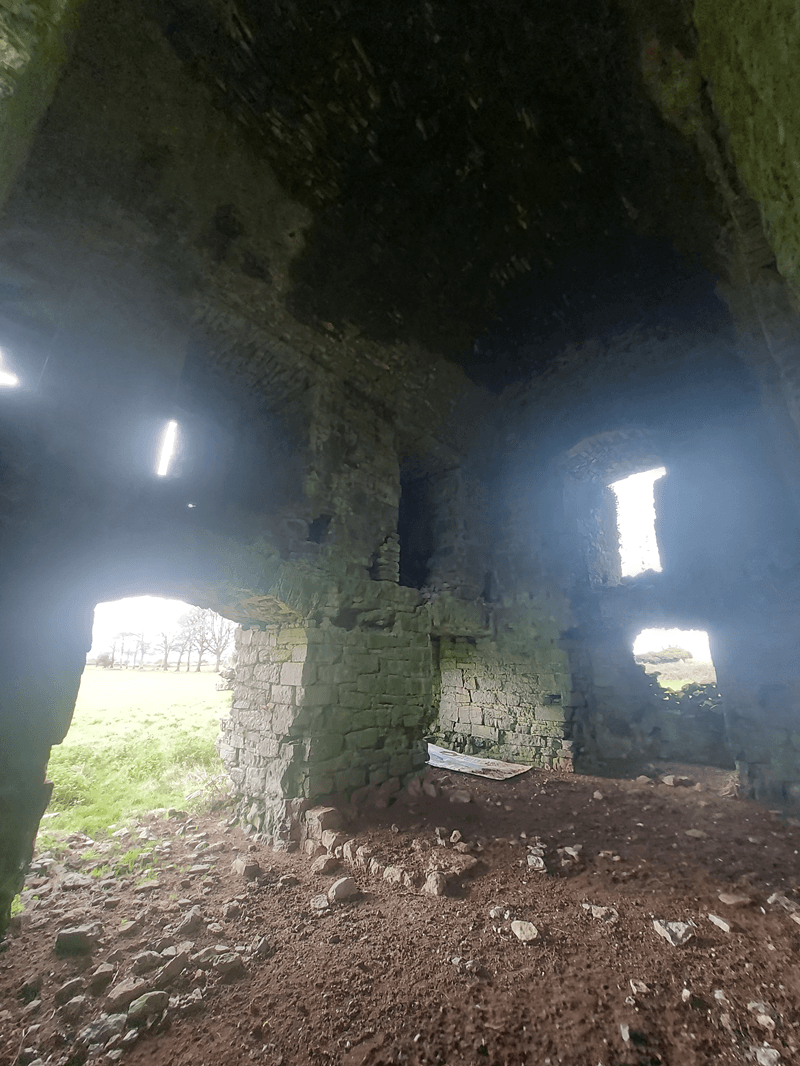
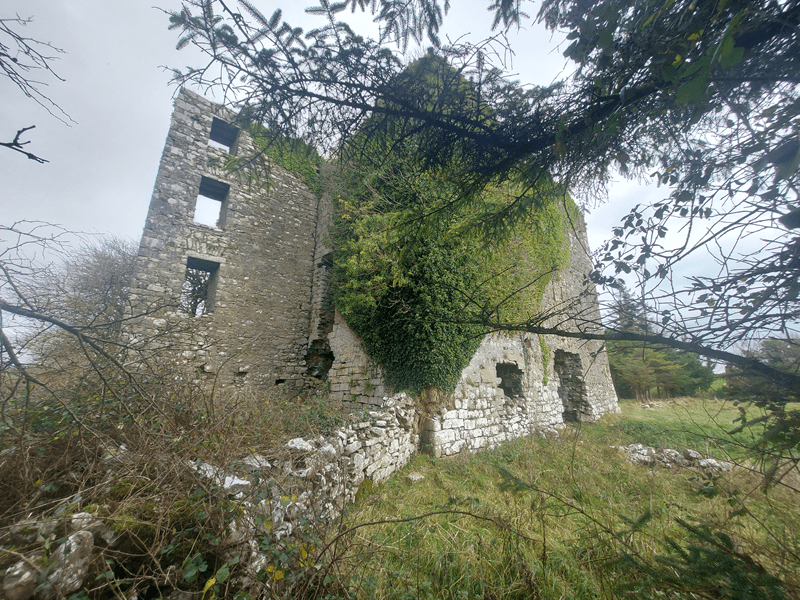
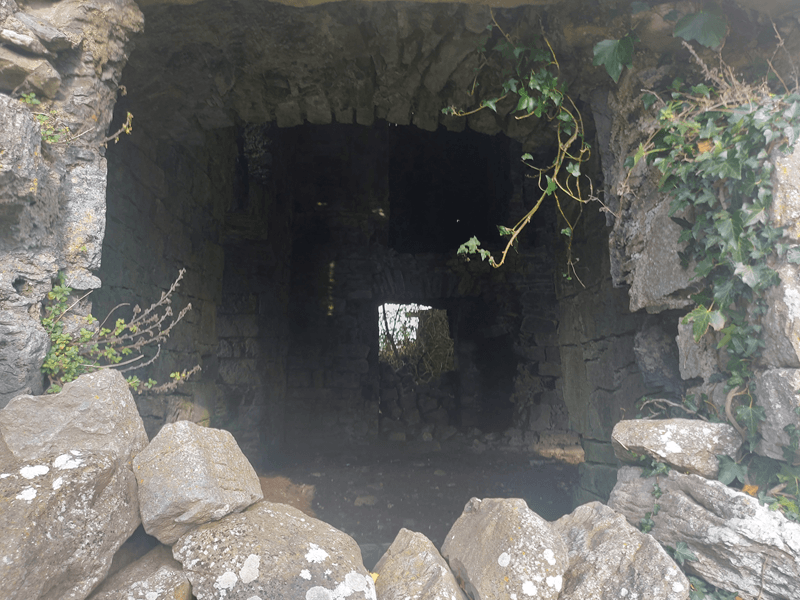
Moyne Castle is a substantial square building with an extension on its north-western side. Its entrance is located in the south-western wall, while an internal staircase runs along the south-eastern wall. The staircase initially rises through ten straight steps, followed by fourteen spiral steps, before coming to an end. A residential range stands to the north-east of the main tower, and a further square tower occupies the north-western corner [2].
Today, Moyne Castle survives as a ruin beside the Black River. Its history reflects the changing fortunes of the Burke, Clanricarde and Blake families, as well as the political and territorial rivalries that shaped the history of Connacht.
References
- [1] Placenames Database of Ireland - Maighin / Moyne
- [2] Irish Stones - Moyne Castle
- [3] Conleth Manning - Excavation at Moyne Graveyard, Shrule, Co. Mayo (1987), Proceedings of the Royal Irish Academy, Vol. 87C, pp. 37–70
- [4] Tony Mulraney - Moyne Castle, Historic Sites of Ireland (8 January 2014)