History
Introduction
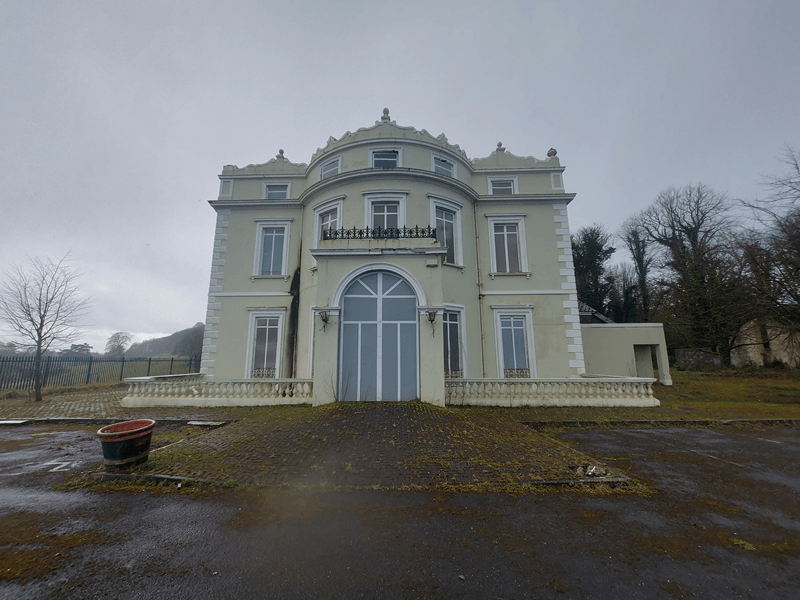
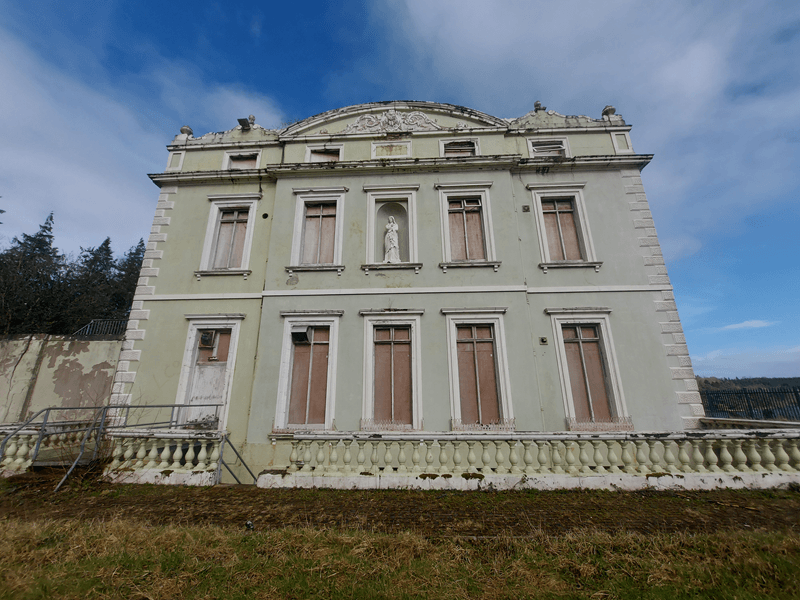
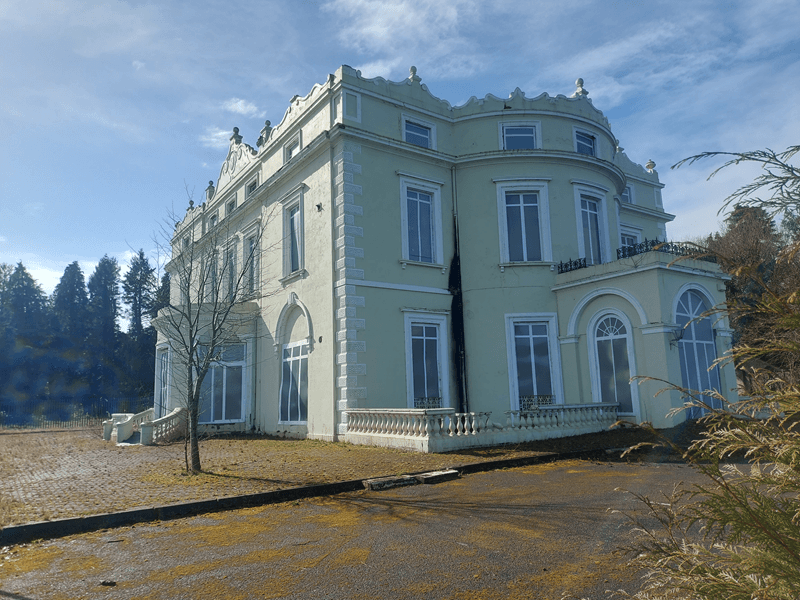
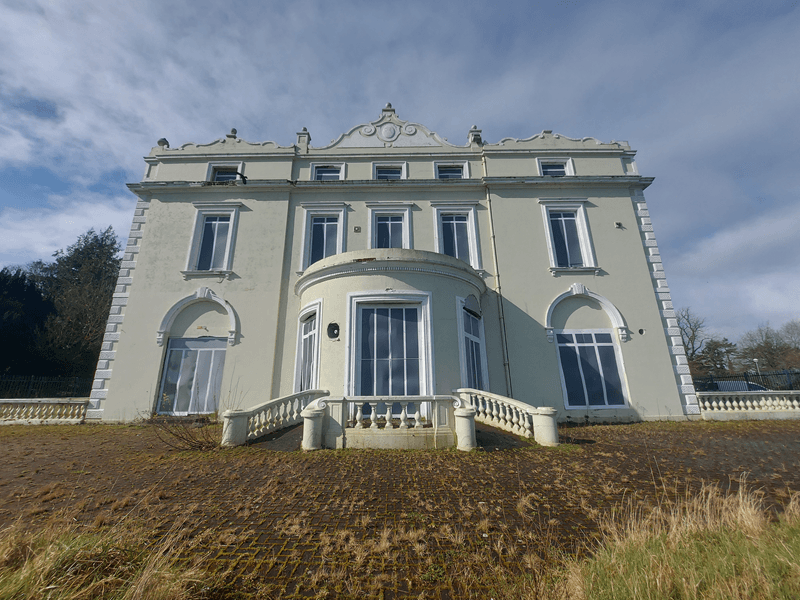
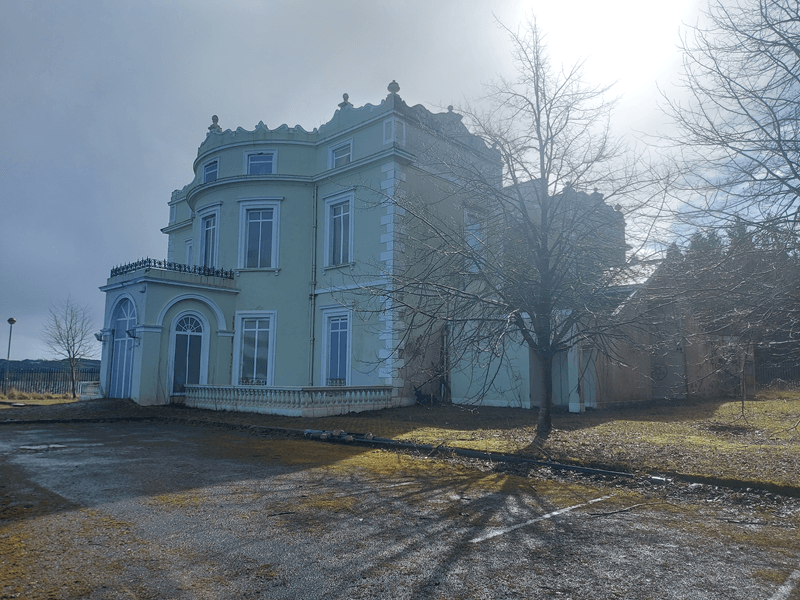
Hope Castle stands on the northern shore of Lough Muckno at Castleblayney in County Monaghan. Although known today as Hope Castle, the building is not a medieval fortress but a late-Georgian country house, built at the end of the eighteenth century for the Blayney family [1], [2].
The history of the site, however, goes back considerably further. Castleblayney takes its name from an earlier fortified residence built by Sir Edward Blayney, a Welsh soldier who received extensive lands in the area during the Plantation of Ulster. The original Blayney Castle stood near the present house, but no visible remains survive today [3], [4].
The surviving Hope Castle therefore represents one chapter in a much longer history of the Blayney estate. Over more than two centuries it has been a Georgian country house, a Victorian estate residence, a royal residence, a military barracks, a hospital, a Franciscan convent and a hotel. Since a devastating fire in 2010, the building has remained unoccupied [1], [2], [5].
Sir Edward Blayney and the first castle
The story of Castleblayney begins in the early seventeenth century. Sir Edward Blayney, a Welsh soldier who had served the English Crown in Ireland, received lands in the Muckno and Ballynalurgan area during the Plantation of Ulster in the early 1600s. He established a fortified residence known as Blayney Castle, around which the later town developed [3], [4].
Blayney was created the first Baron Blayney in 1621. The estate remained associated with the Blayney family for generations, although parts of it were sold during the seventeenth and eighteenth centuries. By the end of the eighteenth century the original fortified castle had become obsolete and was described as derelict [3].
The original castle should not be confused with the present Hope Castle. The old fortified residence stood nearby and gave its name to the town. The Georgian house that survives today was built close to the earlier castle but was a new residence rather than a reconstruction of the medieval or early seventeenth-century building [2], [3], [4].
The Georgian castle
By the late eighteenth century the Blayney family had moved away from the old fortified castle and established a new residence on the estate.
The present house was built for Andrew Thomas Blayney, 11th Baron Blayney, who inherited the estate in 1784. In 1799 he commissioned the architect Robert Woodgate to design the new Blayney Castle. Woodgate had been a pupil of the celebrated architect Sir John Soane, and in a letter to Soane dated 18 November 1799 he described Blayney Castle as the "first House I ever built" [6].
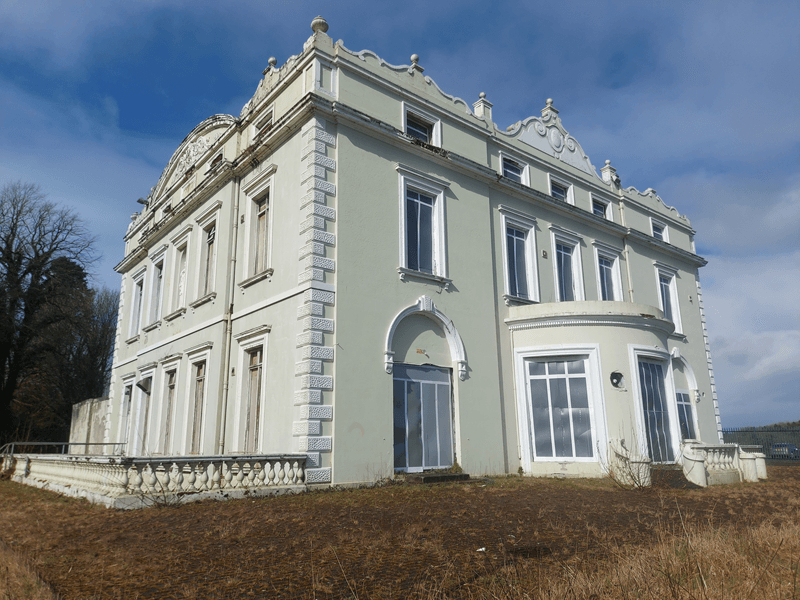
The result was a restrained late-Georgian country house: a five-bay, three-storey building with a basement, designed with the symmetry and proportions characteristic of the period. The house stood within a large demesne beside Lough Muckno and formed the centre of a substantial landed estate [1], [2], [6].
Although it retained the word "castle" in its name, the building was essentially a country house rather than a defensive castle. The continued use of the name reflected the earlier Blayney Castle and the long-established identity of the estate and town [2], [3].
The Blayney estate
Hope Castle was the centre of a large demesne surrounding Lough Muckno. The estate included parkland, gardens, woodland, ornamental features, entrance gates, gate lodges, a walled garden, stables and numerous service buildings [1], [2].
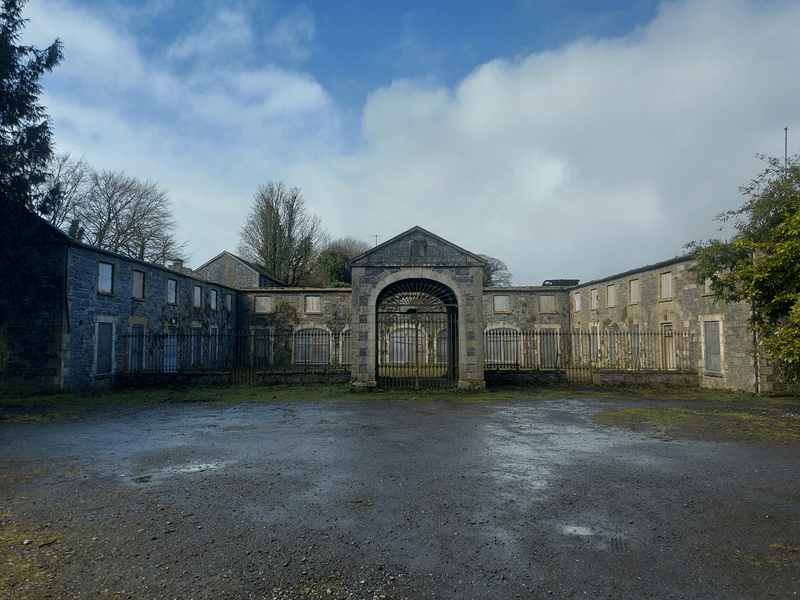
The surviving stable yard is particularly important. The two-storey U-shaped complex was associated with the Georgian estate and was subsequently altered. Its impressive entrance pavilion bears the date 1865, while the National Inventory of Architectural Heritage dates the stable complex itself to around 1799 [7].
Together with the house, walled garden, entrance gates and gate lodges, these surviving structures make the Hope Castle demesne one of the more significant historic estate landscapes in County Monaghan [1], [7].
The Hope family
A major change came in 1853, when Cadwallader Blayney, 12th Baron Blayney, sold the remaining Castleblayney estate to Henry Thomas Hope [8].
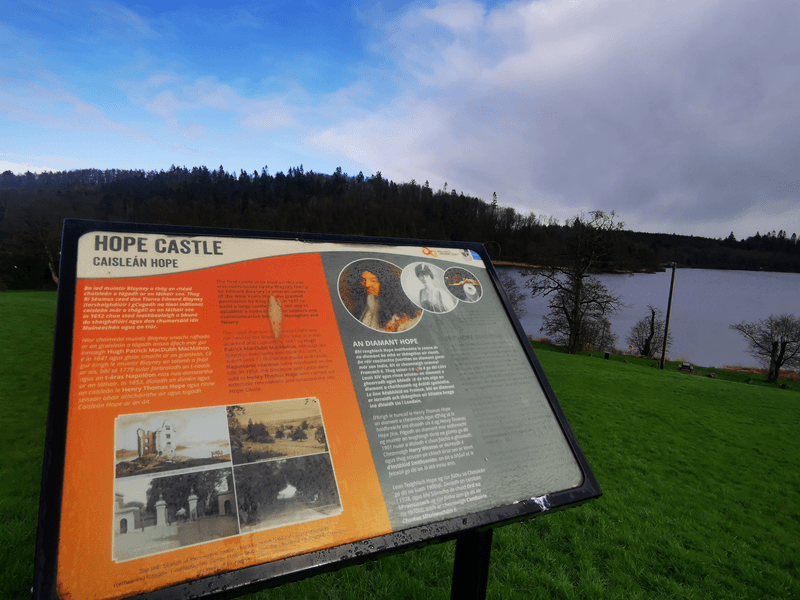
The Hope family originated as merchants and bankers in Amsterdam before establishing themselves in England. Henry Thomas Hope was a wealthy politician and patron of the arts and was heir to the famous Hope Diamond. After purchasing the Castleblayney estate, he renamed the residence Hope Castle, the name by which it has been known ever since [8].
Hope carried out extensive works to the house and estate. The relatively restrained Georgian building received a Victorian transformation, with additional decorative features including elaborate cresting to the parapets and other architectural embellishments. At one stage the entrance was also enhanced by an ornamental cast-iron and glass porch canopy [1], [9].
The alterations gave the house a very different appearance from the building originally designed by Robert Woodgate. Nevertheless, substantial parts of the Georgian structure survived beneath the Victorian additions [1], [9].
The Hope estate
Henry Thomas Hope died in 1862, and the estate subsequently passed to his widow, Anne Adèla Hope. Their daughter, Henrietta Adèla Hope, had married the future 6th Duke of Newcastle-under-Lyne in 1861, bringing the Castleblayney estate into the wider Pelham-Clinton-Hope family [8].
The Hope estate was extensive. In 1876, Anne A. Hope of Castleblayney was recorded as owning approximately 11,700 acres in County Monaghan [8].
The family continued to develop the estate during the nineteenth century. The stable yard and other associated buildings were altered and embellished, while the surrounding demesne was maintained as an important landscaped estate beside Lough Muckno [7], [8].
A royal residence
Hope Castle acquired an unusual royal connection at the beginning of the twentieth century.
Between 1900 and 1904, the castle was leased by Prince Arthur, Duke of Connaught and Strathearn, a son of Queen Victoria. The Duke had been appointed Commander-in-Chief of the British forces in Ireland and used Hope Castle as his private country residence [10].
The Duke and Duchess of Connaught spent part of their time at Castleblayney with their family. Their residence brought a remarkable royal presence to the town, and the arrival of the royal couple in 1900 was reportedly marked by decorations and celebrations throughout Castleblayney [10].
The association was relatively brief. The Duke and Duchess ended their connection with Hope Castle in 1904, but the royal period remains one of the most unusual episodes in the history of the house [10].
The twentieth century
The Hope family's association with Castleblayney eventually came to an end. The family finally left the estate in 1916, as the political landscape of Ireland was undergoing profound change [8].
During the Irish War of Independence, Hope Castle was used as a military barracks by British forces between 1919 and 1921 [1], [2].
The building subsequently underwent another transformation. From 1932 to 1937, it served as Monaghan County Hospital [1], [2]. From the early 1940s, the castle was occupied by Franciscan nuns, who used it as a convent and operated an associated guesthouse. The Franciscan occupation continued until the 1970s [1], [2].
These successive uses illustrate how the role of the great country house was changing. A building originally constructed as the private residence of an aristocratic family was adapted to serve military, medical and religious purposes.
County Council ownership
Following the convent period, Hope Castle entered a prolonged period of decline. Monaghan County Council acquired the castle and surrounding demesne in the 1980s [2], [8].
During subsequent works, substantial nineteenth-century additions to the house and gardens were removed. Some of the original interior was also lost. Among the most notable losses was a Soanesque top-lit upper stair landing, an unusual architectural feature associated with the building's Georgian origins [1], [9].
The changes significantly altered the character of the house, but much of its external Georgian and Victorian architectural fabric survived [1].
Hotel and the 2010 fire
In the early twenty-first century, Hope Castle was given another new use as a hotel and leisure complex. The historic building contained guest accommodation, bar and lounge areas, a restaurant and function facilities [9].
This period came to a tragic end in the early hours of 4 November 2010, when a major fire swept through the building. Monaghan County Council's annual report records that the entire building was engulfed in flames by the time firefighters arrived, requiring the deployment of fire brigades from several towns as well as a hydraulic platform from Dundalk [5].
Contemporary reports stated that the fire caused extensive damage to the interior, destroying furniture, fittings and antiques. Gardaí believed that the fire had been deliberately started after trespassers gained entry to the building [5], [11].
The fire left Hope Castle severely damaged. The building has remained unoccupied since then, while the surrounding estate has continued to form an important part of the historic landscape of Castleblayney [1], [2].
Hope Castle today
Today Hope Castle stands overlooking Lough Muckno as one of the most recognisable historic buildings in County Monaghan.
Its importance lies not simply in the surviving house but in the remarkable sequence of history represented by the entire site. The name recalls the earlier Blayney Castle and the origins of Castleblayney in the seventeenth century; the present building represents the architectural ambitions of the late Georgian period; its Victorian alterations reflect the wealth and taste of the Hope family; its royal connection links it with Queen Victoria's family; and its later uses reflect the political and social transformation of twentieth-century Ireland [1], [2], [8].
The surrounding estate is equally significant. The stable yard, walled garden, gate lodges, entrance gates and other surviving structures preserve evidence of how a large landed estate functioned and developed over two centuries [1], [7].
Hope Castle is therefore best understood not simply as an isolated "castle", but as the centrepiece of a historic landscape that has evolved from the plantation era through the Georgian and Victorian periods and into the modern history of Castleblayney.
References
- [1] National Inventory of Architectural Heritage — Hope Castle, Reg. No. 41308045
- [2] University of Galway — Landed Estates: Blayney/Hope Castle
- [3] University of Galway — Landed Estates: Blayney Estate
- [4] Archiseek — Blayney Castle, Castleblayney, Co. Monaghan
- [5] Monaghan County Council — Annual Report 2010
- [6] Dictionary of Irish Architects — Robert Woodgate
- [7] National Inventory of Architectural Heritage — Hope Castle Stable Yard, Reg. No. 41308044
- [8] University of Galway — Landed Estates: Hope Estate
- [9] Archiseek — Hope Castle, Castleblayney, Co. Monaghan
- [10] Michael Fisher — Castleblayney's Royal Connection
- [11] The Irish Times — Teenagers sent for trial
Other useful links
- Wikipedia, Castleblayney
- Wikipedia, Lough Muckno
- Wikipedia, Edward Blayney, 1st Baron Blayney
- Wikipedia, Blayney family
- Wikipedia, Hope family
- Wikipedia, Henry Thomas Hope
- Wikipedia, Hope Diamond
- Wikipedia, Prince Arthur, Duke of Connaught and Strathearn
- Wikipedia, Plantation of Ulster
- Wikipedia, Irish War of Independence
- Wikipedia, County Monaghan