History
Introduction
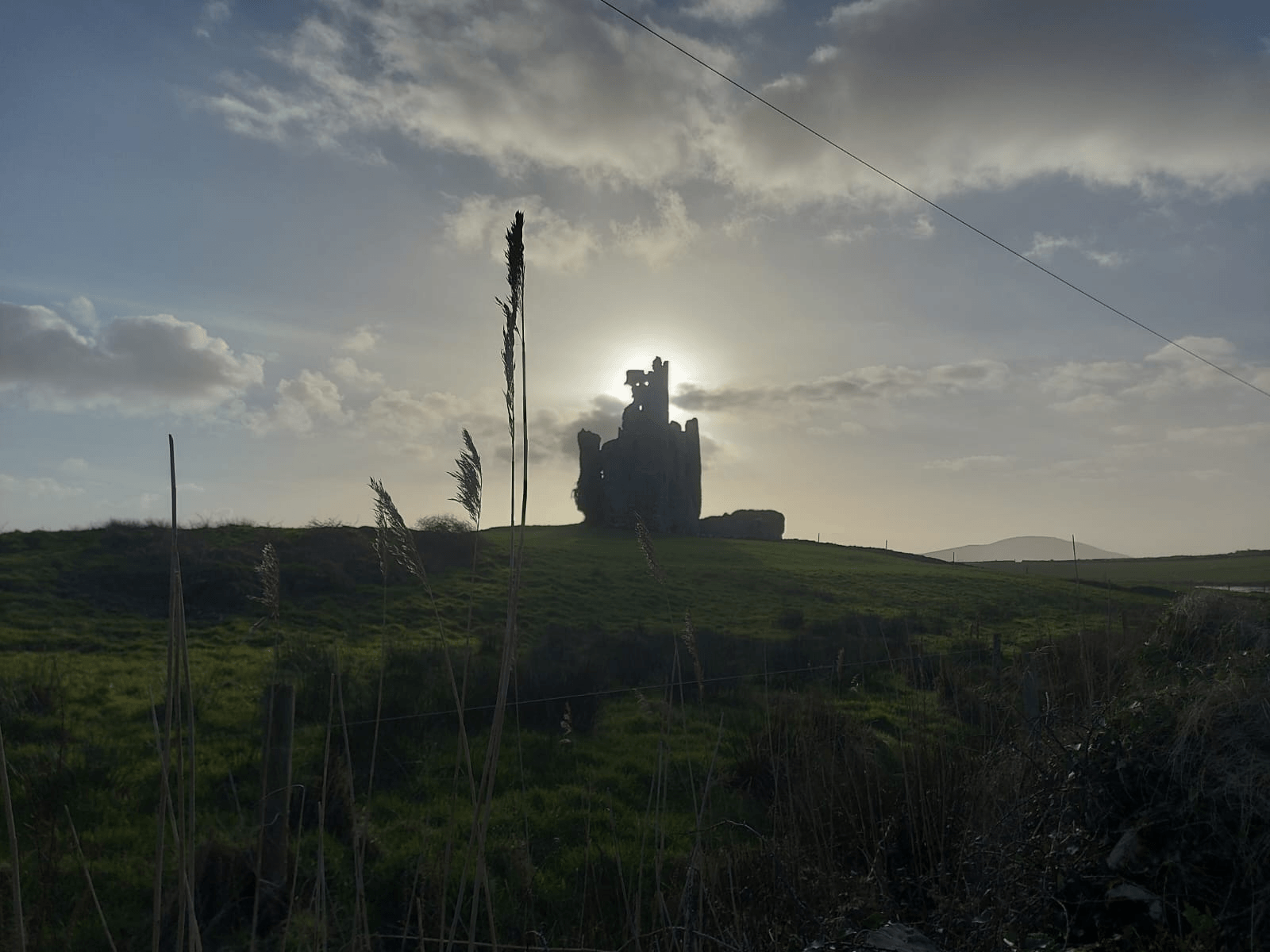
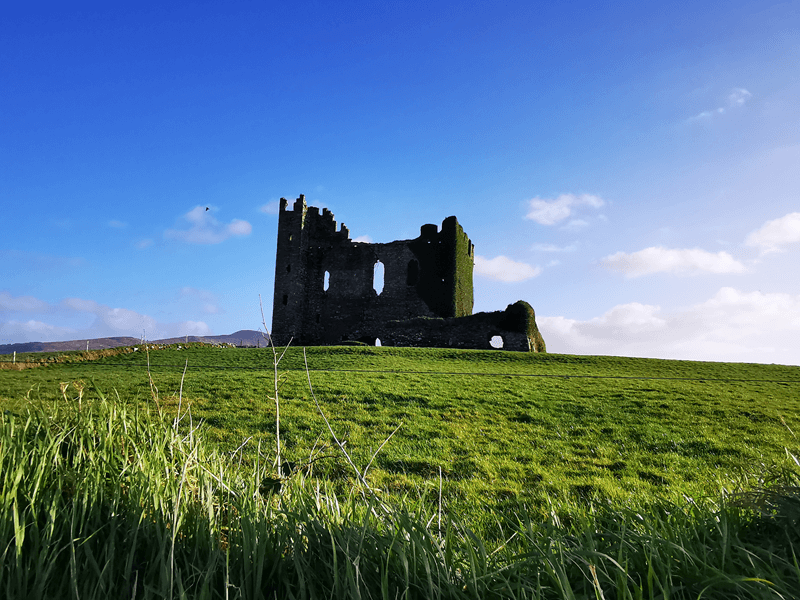
Ballycarbery Castle stands on a low eminence overlooking the tidal estuary of the River Fertha, a short distance west of Cahersiveen in County Kerry. Its position was of considerable strategic importance, commanding the approaches to Valentia Harbour and the waterways leading inland towards Cahersiveen. The castle also forms part of an exceptionally rich archaeological landscape, lying close to the early medieval stone forts of Cahergall and Leacanabuaile [1].
The name Ballycarbery is derived from Baile Uí Chairbre, generally interpreted as "O'Carbery's townland" or "O'Carbery's homestead". Historical records preserve several forms of the name, including Ballycarbry, Ballicarbery and Ballycarberry [2].
The ruins visible today belong principally to a late medieval tower-house, although the history of occupation on the site is considerably older. The castle became one of the principal strongholds associated with the MacCarthy Mór dynasty in south-west Munster and was occupied by members of the O'Connell family, who served as hereditary wardens or constables. In the sixteenth century the castle became caught up in the political struggles between the Gaelic lords of Munster and the expanding authority of the English Crown. Its fortunes subsequently became entangled with those of Sir Valentine Browne before the castle was finally slighted during the Cromwellian conquest of Ireland [1].
An earlier residence on the site
The precise origins of Ballycarbery Castle remain uncertain. Local tradition attributes the construction of the castle to one Carbery O'Shea and claims that the site was already associated with a pre-Norman stronghold. This tradition was recorded in the Schools' Collection in the twentieth century, when local folklore still remembered Carbery O'Shea as the builder of the castle [3].
There is, however, no firm archaeological or documentary evidence that the O'Sheas constructed the surviving castle. The site was certainly associated with the MacCarthy dynasty at an early date. The archaeological survey of the Iveragh Peninsula notes that some form of residence existed at Ballycarbery in 1398, when the annals record the death there of Taghd Mac Carthaigh [1].
This is important evidence because it demonstrates that a residence belonging to the MacCarthy sphere of power existed at Ballycarbery by the late fourteenth century, although it does not prove that the present masonry castle had yet been constructed. The existing ruins are later in date [1].
The present castle is generally associated with the late fifteenth or sixteenth century. The archaeological evidence suggests that the surviving structure should be regarded as a later medieval building, rather than the residence recorded in 1398 [1].
The MacCarthy Mór stronghold
By the later Middle Ages the MacCarthy Mórs had established a network of important residences and strongholds throughout south-west Munster. Ballycarbery was one of the principal castles associated with their lordship in Iveragh. Its position overlooking the entrance to Valentia Harbour was particularly valuable, giving its occupants a commanding position over an important Atlantic harbour and the maritime approaches to the western part of the peninsula [1].
The surviving tower-house is probably the castle referred to in a document of 1569 as "the castle of Valencyen called Ballycarborow". By 1594 it was explicitly recorded as a MacCarthy Mór castle, confirming its place within the lordship at the end of the sixteenth century [1].
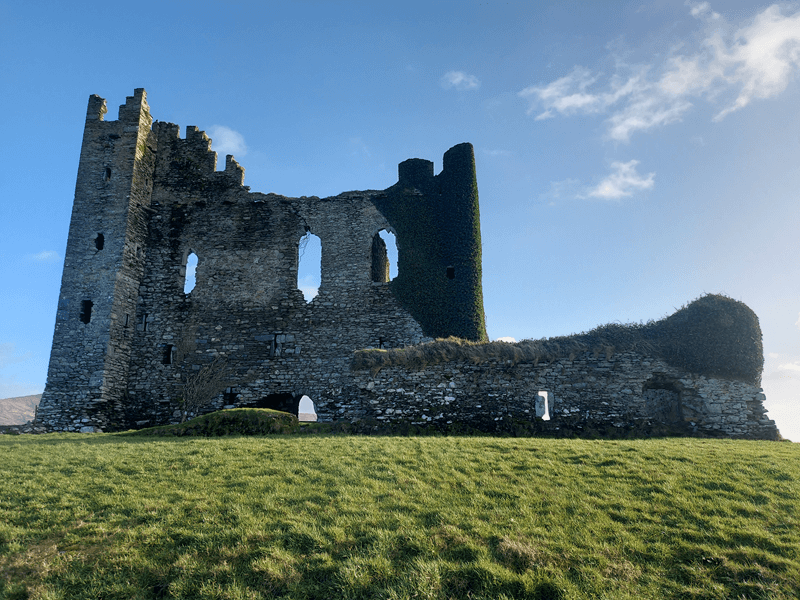
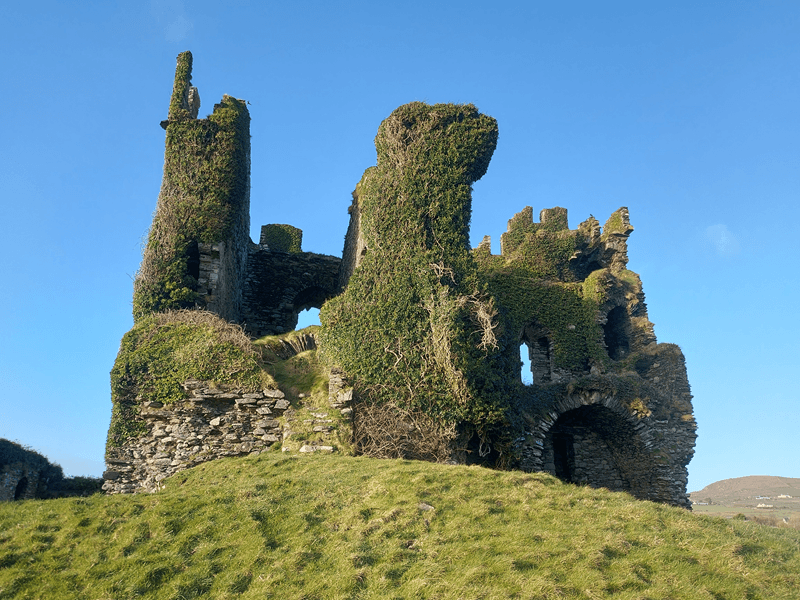
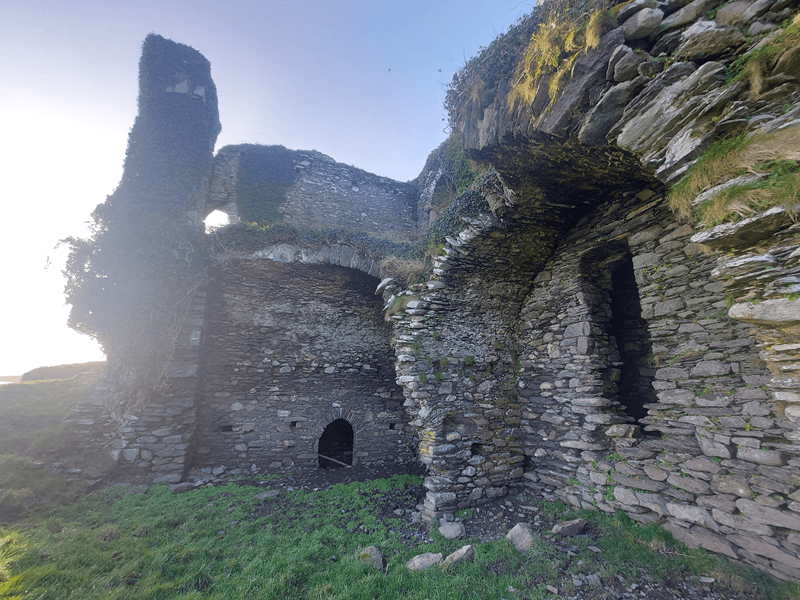
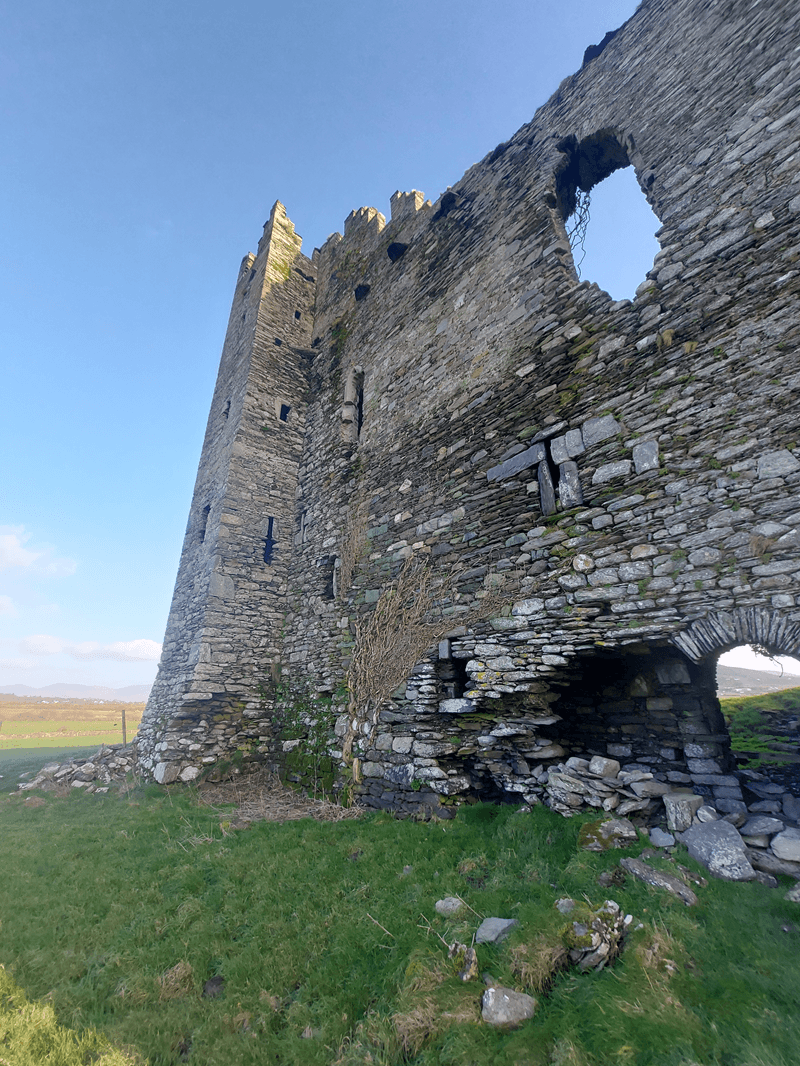
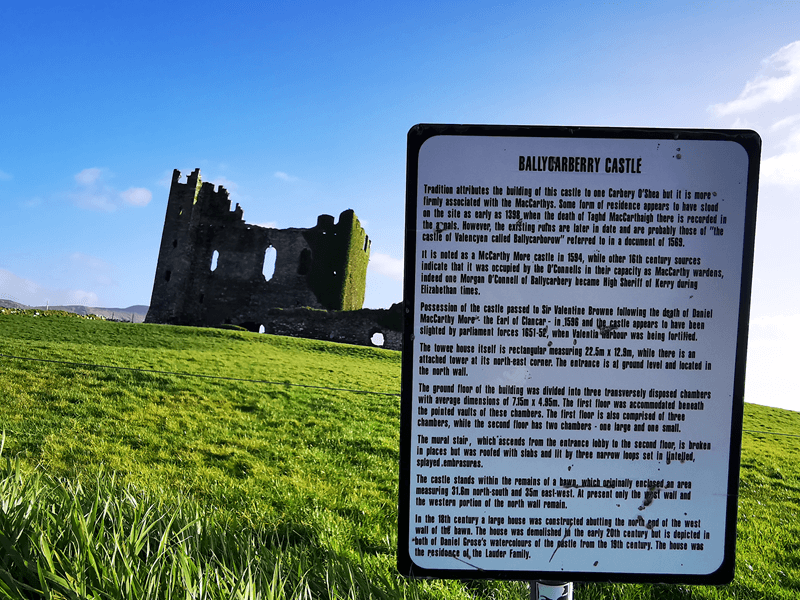
The tower-house itself is a substantial rectangular building, approximately 22.5 metres by 12.9 metres, with an additional tower projecting at its north-eastern corner. The entrance is positioned on the northern side. The building originally contained several vaulted chambers, upper residential rooms and mural passages, while a substantial bawn enclosed the castle [1].
Ballycarbery therefore combined defensive and residential functions. Its substantial walls, narrow defensive openings and protected entrance provided security, while its larger windows, upper chambers and extensive internal accommodation reflected the status of the family or lordly household associated with it [4].
The O'Connells, hereditary wardens of Ballycarbery
Although Ballycarbery was associated with the MacCarthy Mórs, the castle was occupied and administered by members of the O'Connell family. They acted as hereditary wardens or constables of the castle on behalf of the MacCarthy Mór lords [1].
Sixteenth-century records identify members of the family at Ballycarbery. The Placenames Database of Ireland records Mortagh McShane Y Connell and Shiraughe O Connell at Ballycarbery in 1586, while other contemporary records identify O'Connells of Ballycarbery as MacCarthy wardens [2], [1].
The family became an important local dynasty in its own right. One Morgan O'Connell of Ballycarbery became High Sheriff of County Kerry during the reign of Elizabeth I, demonstrating the considerable status achieved by the family within the changing political structure of late sixteenth-century Kerry [1].
Later genealogical traditions connect the Ballycarbery O'Connells with the family from which Daniel O'Connell, the nineteenth-century political leader known as "the Liberator", descended. The association is genealogical rather than chronological: Daniel O'Connell was born in 1775, more than a century after Ballycarbery had ceased to function as a major stronghold [5].
Ballycarbery and the Atlantic world
The location of Ballycarbery was important not only militarily but also economically. The castle overlooked the River Fertha and the approaches to Valentia Harbour, connecting the MacCarthy lordship with the Atlantic seaboard. The importance of controlling this maritime position is reflected in late sixteenth-century correspondence and surveys concerning the MacCarthy lands [2].
The castle's position also placed it within the wider network of Atlantic connections maintained by south-western Ireland. Local traditions preserve stories of Spanish wine and other goods being brought into the harbour, although such individual stories are difficult to substantiate in detail. They nevertheless reflect the broader importance of maritime connections between Kerry, Iberia and other parts of the Atlantic world [3].
The sixteenth century and the changing political order
During the sixteenth century the traditional Gaelic political order in Kerry came under increasing pressure from the Tudor state. Ballycarbery remained associated with the MacCarthy Mórs, but the political position of the dynasty became progressively more complicated as the English Crown attempted to impose its authority over Munster [1].
The castle was recorded as a MacCarthy Mór stronghold in 1594, while the O'Connells continued to occupy it in their traditional role as wardens [1].
The death of Daniel MacCarthy Mór, Earl of Clancarty, in 1596 marked a decisive turning point. Daniel had accumulated substantial debts, and Sir Valentine Browne had acquired mortgages over parts of the MacCarthy Mór demesne. The Clancarthy Survey of 1598 subsequently described Ballycarbery as "The Castle of Sir Valentine Browne", providing strong documentary evidence for Browne's possession or control of the property [2].
Florence MacCarthy and the MacCarthy lands
The change in possession did not go uncontested. Following Daniel MacCarthy Mór's death, Florence MacCarthy, the prominent MacCarthy leader who had married Daniel's daughter Ellen, attempted to recover the MacCarthy Mór inheritance.
In a petition to Sir Robert Cecil around February 1597, Florence specifically claimed a group of demesne lands including "Castell logh, the Palice, and Balcarbry". He argued that these lands formed part of the inheritance of his father-in-law, the late Earl of Clancarty, and sought royal recognition of his claim [6].
The document illustrates how the fate of Ballycarbery had become intertwined with the wider struggle between Gaelic inheritance, English law and the Crown's policy of transforming traditional lordships into estates held under English tenure [6].
The O'Connells in the early seventeenth century
The O'Connells continued to have a presence at Ballycarbery after the transfer of the MacCarthy lands. Genealogical records identify Maurice O'Connell of Ballycarbery and his descendants among the family members associated with the castle [5].
Geoffrey O'Connell, who died in 1639, is recorded as having lived at Ballycarbery and held the office of High Sheriff of Kerry. The family therefore remained closely connected with the castle during the decades immediately preceding the Confederate Wars and Cromwellian conquest [5].
By this time, however, the political environment of Ireland had changed dramatically. The old Gaelic system of hereditary lordship had been weakened by Tudor and early Stuart policies, while religious divisions and disputes over land ownership were becoming increasingly acute.
The Wars of the 1640s
The outbreak of the Irish Rebellion of 1641 and the subsequent Wars of the Three Kingdoms transformed the political situation in Kerry. The region became contested, and castles that had once functioned primarily as residences and local strongholds could again acquire military importance.
The O'Connell family remained associated with Ballycarbery during this period. Later accounts identify Maurice O'Connell as one of the members of the family connected with the castle during the turbulent years immediately preceding the Cromwellian conquest [5].
The castle's position overlooking Valentia Harbour made it strategically significant during the Parliamentarian campaign in south-west Kerry. Its subsequent destruction was connected with the efforts of Parliamentarian forces to secure and fortify the harbour [1].
The Cromwellian destruction
The final decisive event in Ballycarbery's history occurred during the Cromwellian conquest of Ireland.
Parliamentarian forces were active in south-west Kerry in 1651–52 while securing the harbours and strongholds of the region. Ballycarbery appears to have been attacked and slighted during this period, when Valentia Harbour was being fortified [1].
Local tradition preserved a more dramatic account of the event. The Schools' Collection records a story that Cromwell's forces approached the castle from the direction of Valentia Harbour and that the occupants escaped through a supposed subterranean passage. The same tradition states that the castle was subsequently razed [3].
There is no archaeological evidence demonstrating the existence of such an underground passage, and the story should therefore be regarded as folklore rather than established fact. The archaeological evidence and historical references nevertheless support the conclusion that Ballycarbery was deliberately rendered unusable as a stronghold during the Parliamentarian conquest [1].
From stronghold to ruin
Following its destruction, Ballycarbery ceased to function as a major castle. The surviving masonry gradually became a ruin, although the site was not entirely abandoned.
During the eighteenth century a substantial house was constructed against the surviving bawn wall. The house was occupied by the Lauder family and survived into the nineteenth century. It was subsequently demolished, probably in the early twentieth century [4].
The later house was recorded in antiquarian drawings and watercolours, including depictions associated with Daniel Grose. These images provide valuable evidence for the appearance of the ruins and the later domestic buildings before their eventual demolition [4].
The addition of a later house against the medieval bawn is an important reminder that Ballycarbery was not simply abandoned after the Cromwellian wars. Instead, parts of the medieval complex were incorporated into a later domestic landscape.
Antiquarian interest and the twentieth century
By the nineteenth and early twentieth centuries Ballycarbery had become an important antiquarian landmark. Its dramatic position, substantial surviving masonry and associations with the MacCarthy Mórs and O'Connells attracted increasing attention from historians and antiquaries.
Robert Cochrane published a short account of Ballycarbery Castle in the Journal of the Royal Society of Antiquaries of Ireland in 1910. His article is particularly valuable because it records the condition of the ruins at a time when parts of the bawn were still being removed [7].
The southern portion of the bawn was partly dismantled in the early twentieth century, while other sections of the perimeter wall had already disappeared. The surviving remains therefore represent only part of the medieval enclosure [1], [7].
The surviving castle
Ballycarbery's surviving remains consist principally of the substantial tower-house and portions of the surrounding bawn. The main building is rectangular in plan and measures approximately 22.5 metres by 12.9 metres, with a small projecting tower at the north-eastern corner [1].
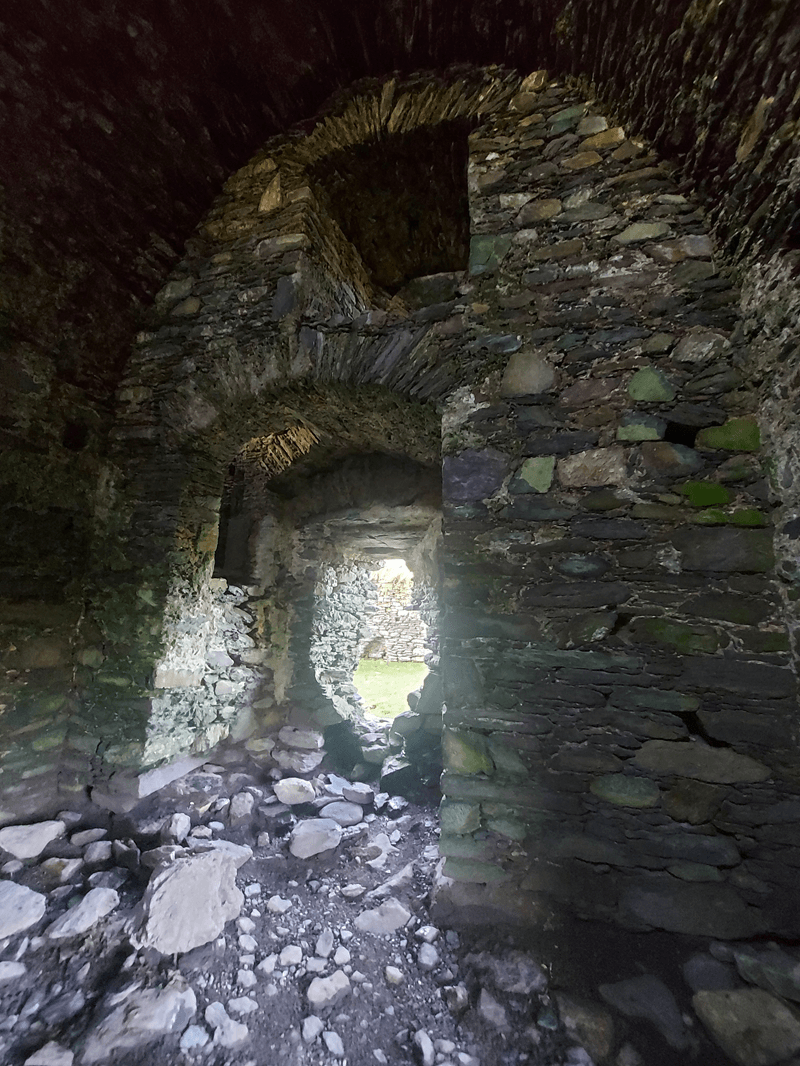
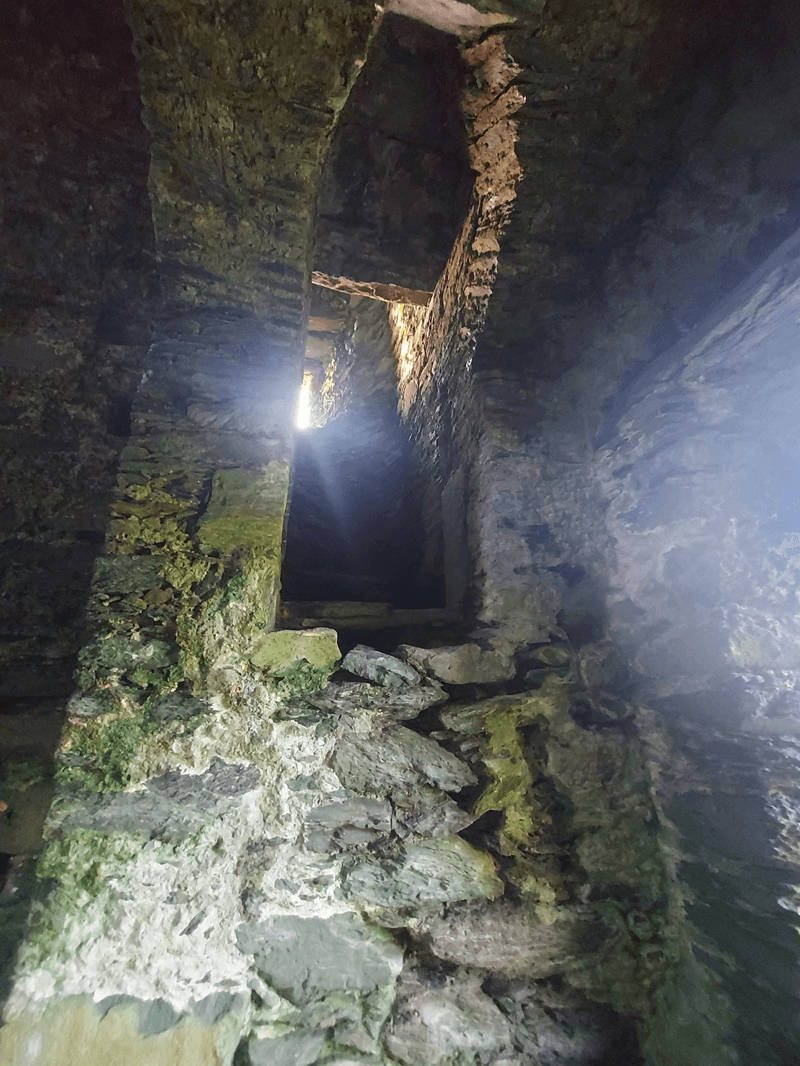
The entrance is on the northern side. The ground floor was divided into three substantial chambers beneath vaulted ceilings, while the upper levels contained further accommodation. A mural staircase connected the various floors and was lit by narrow defensive openings [1].
The castle originally stood within a bawn measuring approximately 31.6 metres north to south and at least 35 metres east to west. Only the western wall and part of the northern wall survive today, although other portions of the enclosure can still be traced [1].
The surviving architecture demonstrates the dual purpose of the Irish tower-house. Ballycarbery was a defensive stronghold, but it was also a residence intended for an important Gaelic household. Its substantial walls and defensive openings provided security, while its larger windows and spacious upper rooms reflected status and comfort [4].
Ballycarbery and the landscape of Iveragh
One of the most remarkable aspects of Ballycarbery is the way in which it forms part of a much older landscape of power. Nearby Cahergall and Leacanabuaile are major early medieval stone forts, demonstrating that the area had already been an important centre of settlement and elite activity many centuries before the construction of the present castle [1].
The later castle therefore did not arise in an isolated landscape. It occupied a strategic location that had remained attractive to successive communities because of its position above the estuary, its access to the sea and its proximity to the lands around Cahersiveen.
From the early medieval period to the age of the MacCarthy Mórs, from the Elizabethan conquest to the Cromwellian wars, Ballycarbery remained connected with the changing political geography of south-west Kerry.
Conclusion
Ballycarbery Castle is one of the most evocative medieval ruins in County Kerry because its history reflects the transformation of Gaelic Ireland itself.
A residence associated with the MacCarthy Mór dynasty was already established here by the late fourteenth century, when the death of Taghd Mac Carthaigh was recorded at Ballycarbery. The surviving tower-house belongs to a later period and became one of the principal MacCarthy Mór strongholds in Iveragh. For generations the castle was entrusted to the O'Connells, hereditary wardens whose family remained associated with Ballycarbery into the seventeenth century [1], [5].
The political upheavals of the sixteenth century brought the castle into the orbit of English Crown policy, and the death of Daniel MacCarthy Mór in 1596 contributed to the transfer of the castle and its associated lands into the hands of Sir Valentine Browne [2].
By the middle of the seventeenth century, however, Ballycarbery's role as a Gaelic stronghold had come to an end. Parliamentarian forces attacked and slighted the castle during the Cromwellian conquest, leaving the great tower-house permanently ruined [1].
Later generations adapted the site to new purposes, with the Lauder family occupying a house constructed beside the medieval remains. By the early twentieth century the castle was also attracting increasing antiquarian attention, although parts of its bawn were dismantled and removed [4], [7].
Today, although much of Ballycarbery has disappeared, the surviving walls remain a powerful reminder of the political and cultural world of the MacCarthy Mórs and their O'Connell wardens. Rising above the River Fertha and facing the Atlantic approaches to Valentia Harbour, the castle still occupies the strategic landscape that made it important for centuries.
References
- [1] Iveragh Heritage Profile — Ballycarbery Castle and Bawn
- [2] Placenames Database of Ireland — Baile Uí Chairbre Theas / Ballycarbery South
- [3] Dúchas — The Schools' Collection: Local History of Ballycarbery Castle
- [4] Castles.nl — Ballycarbery Castle
- [5] The Early O'Connell (O'Conaill) Family History
- [6] CELT, University College Cork — Letter Book of Florence Mac Carthy Reagh
- [7] National Library of Ireland — Robert Cochrane, "Ballycarbery Castle, Co. Kerry", 1910
Other useful links
- Dúchas — Local History of Ballycarbery Castle, continuation
- CELT — Letter Book of Florence Mac Carthy Reagh
- CELT — The Desmond Survey
- National Library of Ireland — Picture of Ballycarbery Castle
- Castles.nl — Ballycarbery Castle
- Placenames Database of Ireland — Ballycarbery
- Wikipedia — Ballycarbery Castle