History
The Norman Foundation
Askeaton occupies one of the most naturally defensible sites in County Limerick: a rocky island in the River Deel, close to the point where the river approaches the Shannon Estuary. The position controlled an important crossing and offered both a defensive advantage and access to the waterways leading towards the Shannon. The name Askeaton is generally derived from the Irish Eas Géitine, meaning the “waterfall of Géitine”, and may preserve the name of a pre-Christian tribe that held western Limerick. The area was occupied long before the arrival of the Anglo-Normans, and the Book of Rights, written around 1100, refers to the fort of Geibhtine, associated with this ancient tribe [1].
A castle was established at Askeaton in 1199, during the period of rapid Anglo-Norman expansion in Munster. The Annals of Inisfallen record the construction of a castle at Askeaton in that year. The foundation has traditionally been associated with William de Burgo, although Hamo de Valognes, Justiciar of Ireland from 1197 to 1199, also held extensive lands in the region and is closely associated with the earliest phase of the castle's history. The site subsequently passed between several Anglo-Norman magnates during the following decades [1], [2].
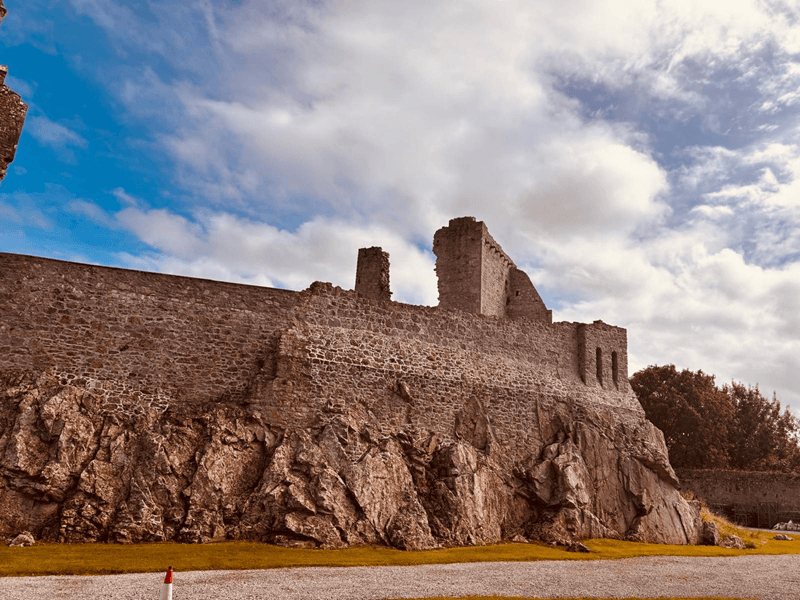
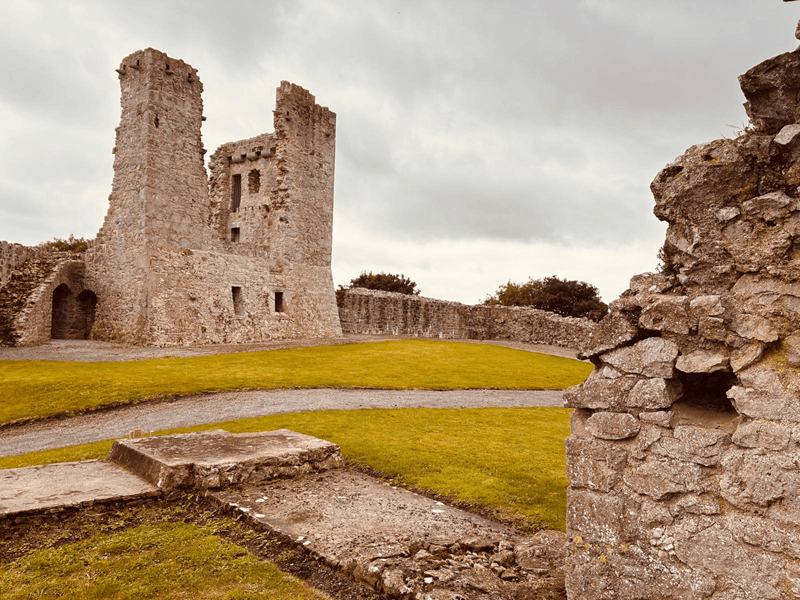
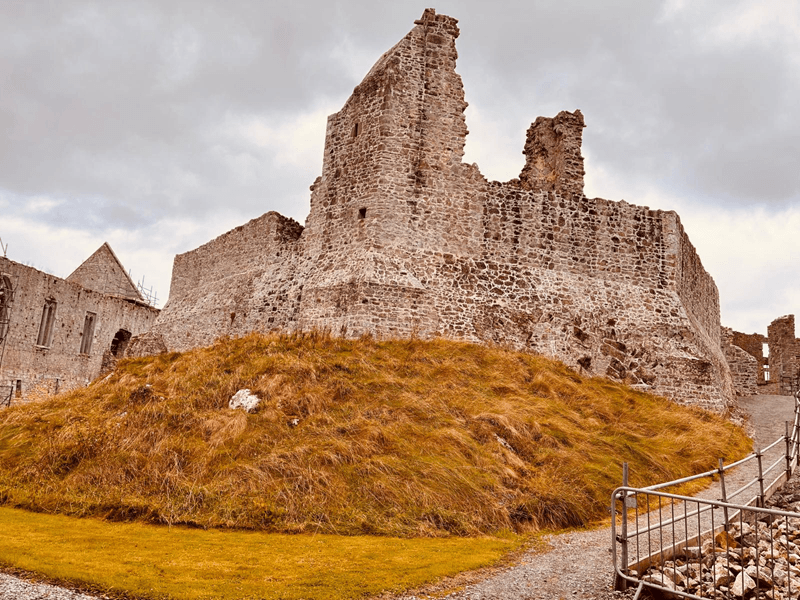
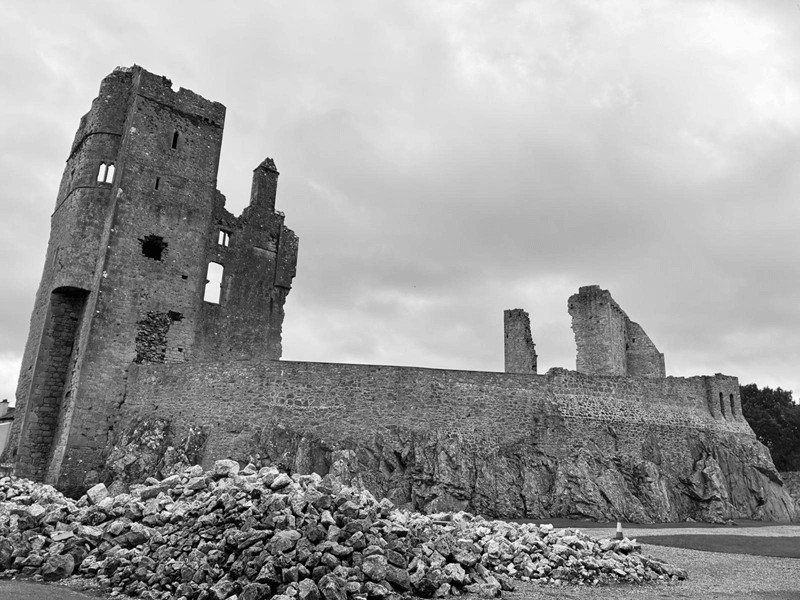
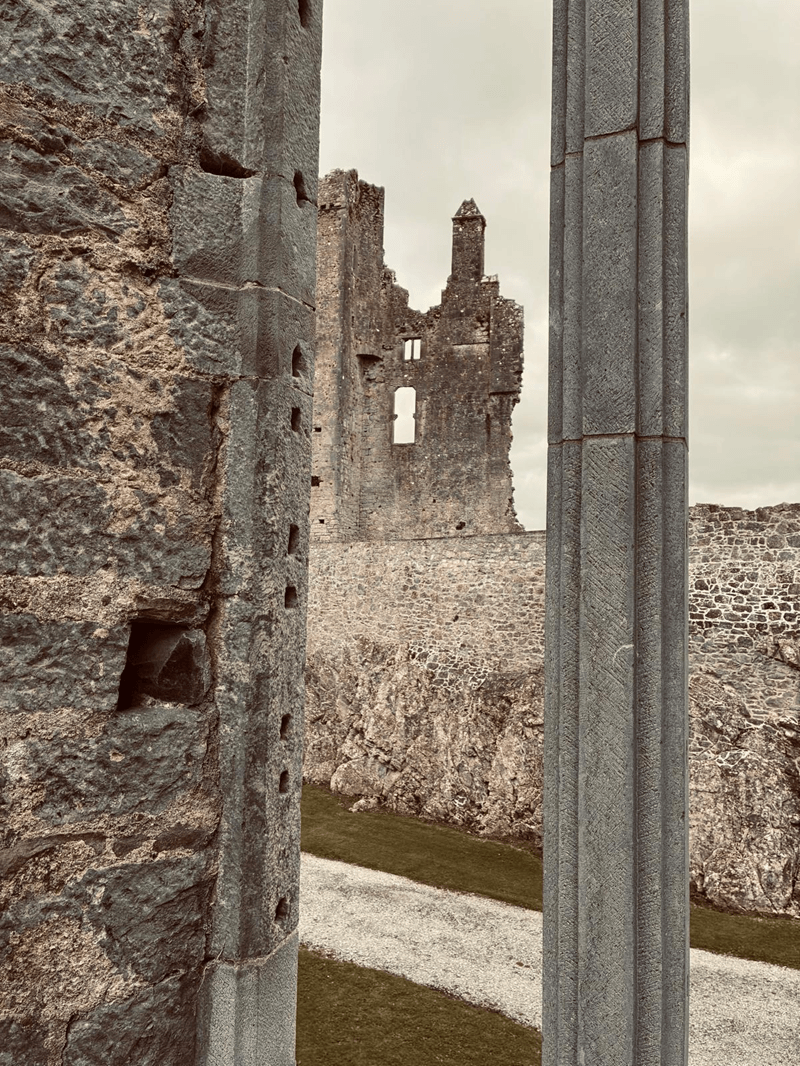
The original fortress was a typical Anglo-Norman motte-and-bailey in concept, but with an important peculiarity: its elevated “motte” was the naturally raised limestone rock of the island rather than an artificial mound. The surviving remains demonstrate that the medieval fortress was considerably more complex than the ruins might initially suggest. The castle developed around an outer ward occupying most of the island and an inner ward situated on the higher central rock. Parts of the curtain wall and substantial masonry preserve evidence of the earlier medieval phases [1].
The Medieval Stronghold
During the thirteenth and early fourteenth centuries Askeaton formed part of the changing network of Anglo-Norman lordships in west Limerick. By the beginning of the fourteenth century the settlement had developed into a substantial medieval community. In 1300, the town contributed forty shillings towards the military subsidy raised for Edward II's wars in Scotland, an indication of its economic and administrative importance [1].
The castle and surrounding lordship passed through a succession of Anglo-Norman hands. Richard de Clare and other magnates were associated with the area before Askeaton entered the sphere of the FitzGeralds. These changes reflected the unstable political landscape of medieval Munster, where royal grants, inheritance, military power and alliances continually altered the distribution of territory [1], [3].
The decisive change came in the fourteenth century, when Askeaton became part of the growing Desmond Geraldine sphere of influence. Maurice FitzThomas FitzGerald, who became the first Earl of Desmond in 1329, established the FitzGeralds as one of the most powerful dynasties in Munster. By 1348 Askeaton had become one of their principal residences, and it would remain closely associated with the Earls of Desmond for more than two centuries [1], [2].
The importance of Askeaton to the Desmonds was not simply military. The castle was the centre of a lordship from which the FitzGeralds exercised political, economic and judicial influence over a large part of Munster. The Desmonds' authority existed within a complex world in which Anglo-Norman, Gaelic and royal institutions overlapped, and the family became increasingly integrated into the Gaelic political and cultural environment of Munster.
The Desmond Castle
Although the origins of Askeaton Castle lie in the Norman period, much of what survives today belongs to major rebuilding campaigns undertaken under the Earls of Desmond. The archaeological evidence shows that the thirteenth-century structures were substantially altered and enlarged during the fifteenth century. The castle therefore represents several centuries of architectural development rather than a single building erected at one time [1].
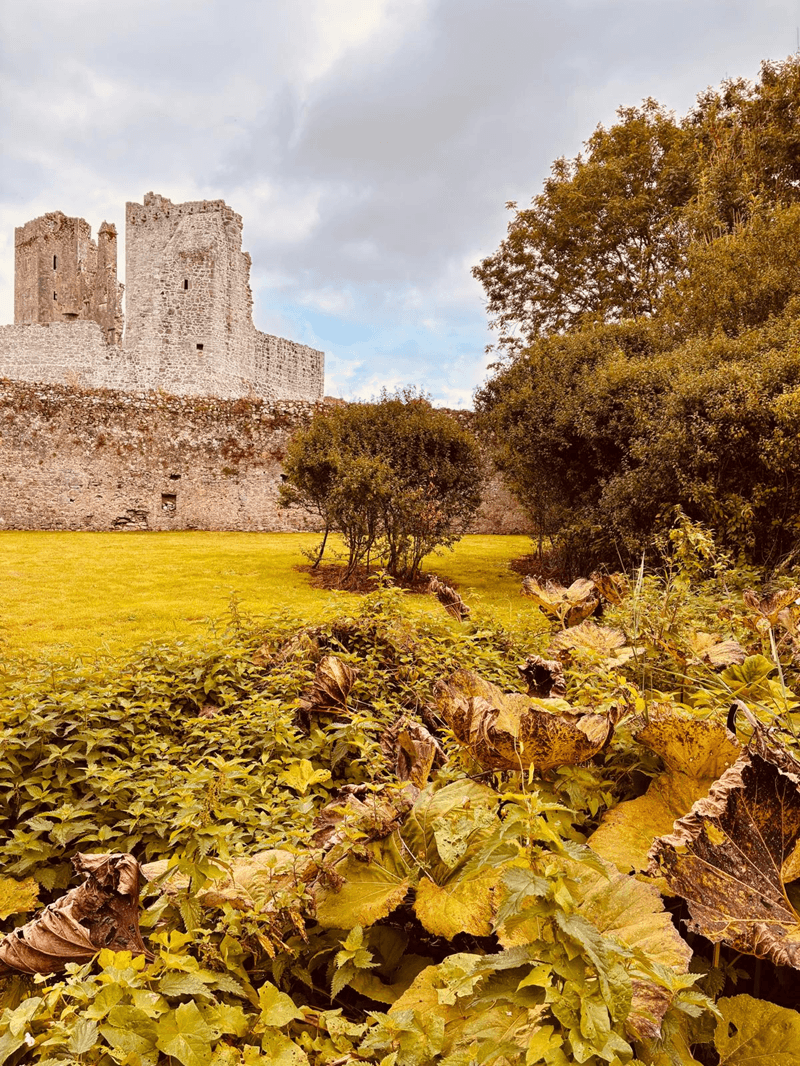
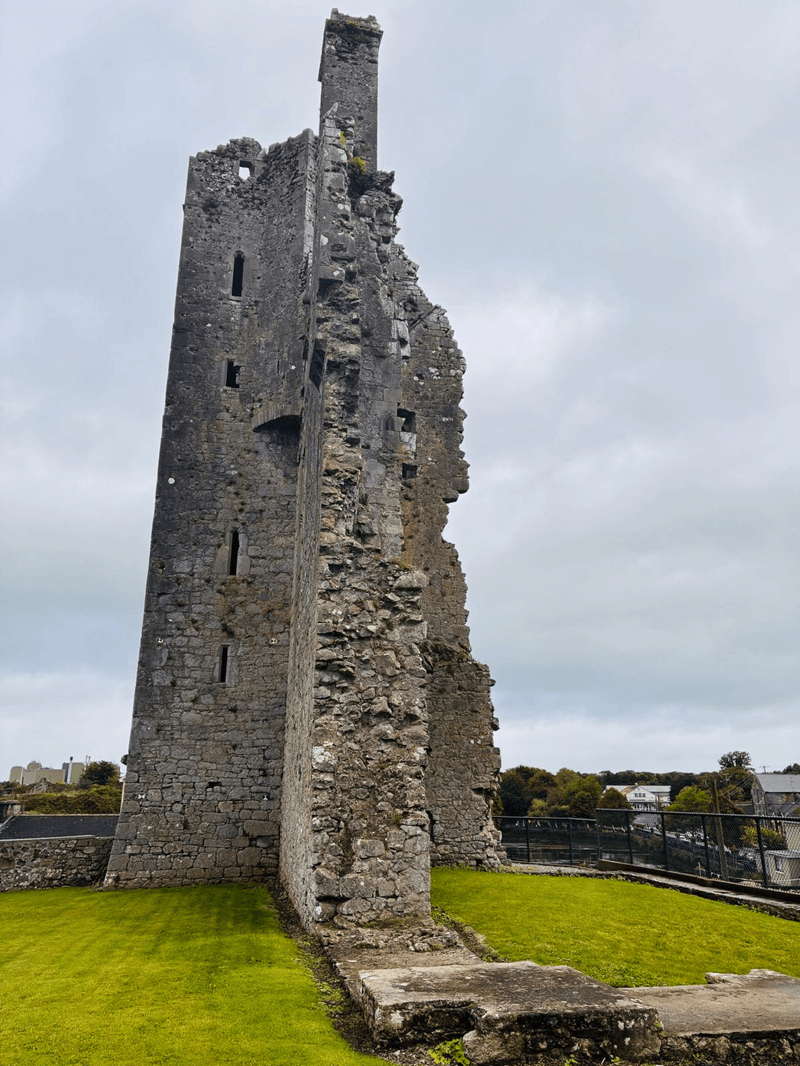
The outer ward follows the roughly lozenge-shaped outline of the island, while the inner ward occupies the higher central limestone outcrop. The entire complex was constructed principally from local limestone. The arrangement provided several layers of defence, while the River Deel itself formed a natural barrier around the stronghold [1].
The castle's entrance was approached from the bridge by a causeway leading onto the island. Archaeological monitoring has identified evidence for an earlier entrance arrangement, including a void probably associated with a former drawbridge. Although the surviving gateway represents a later arrangement, this evidence helps reconstruct the more formidable medieval approach to the fortress [4].
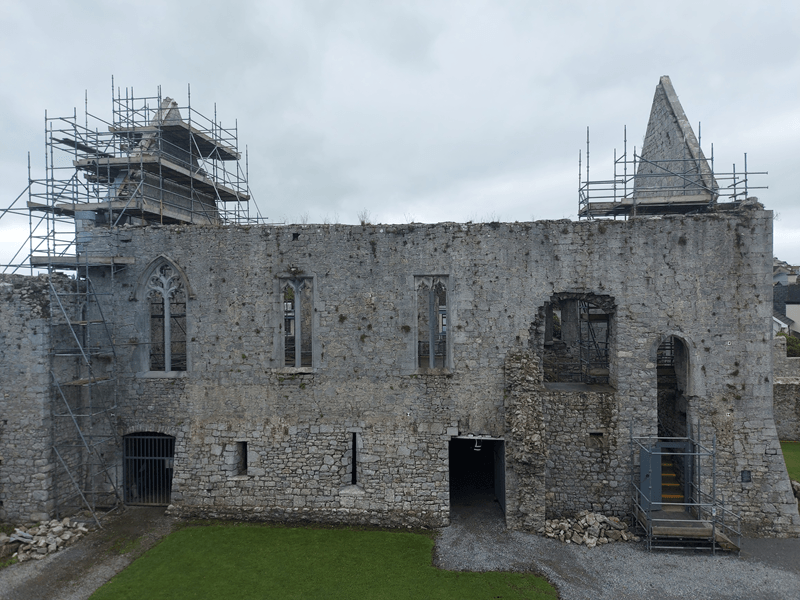
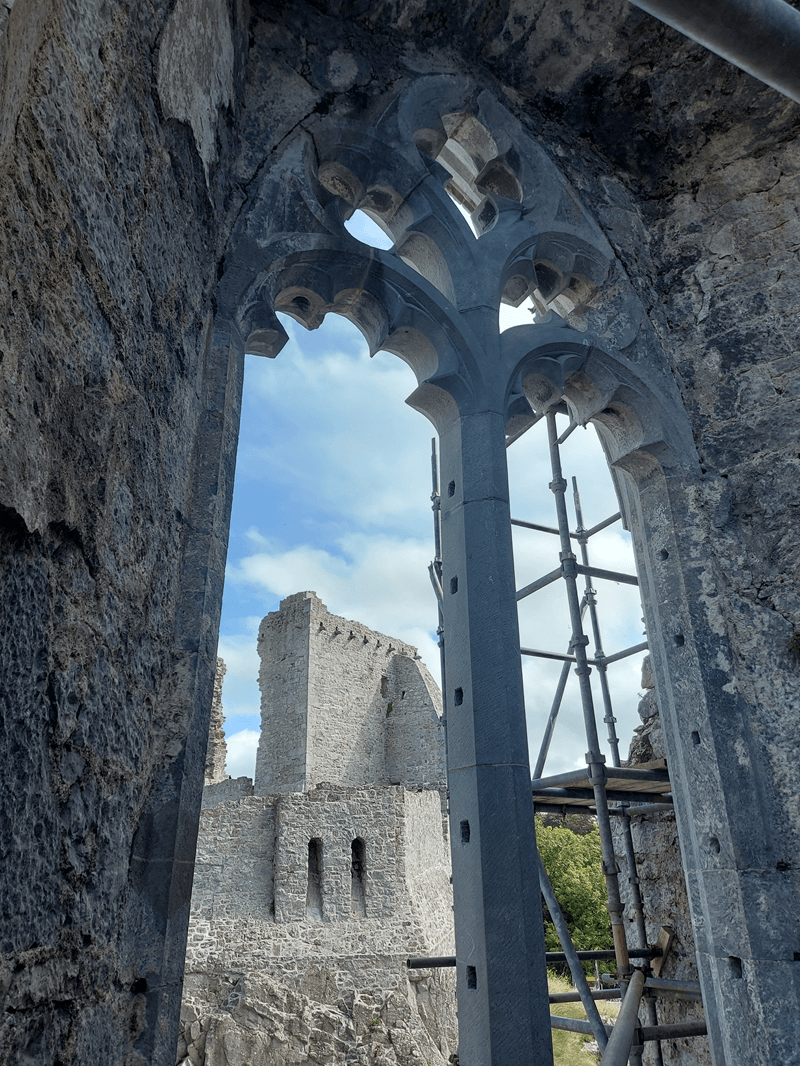
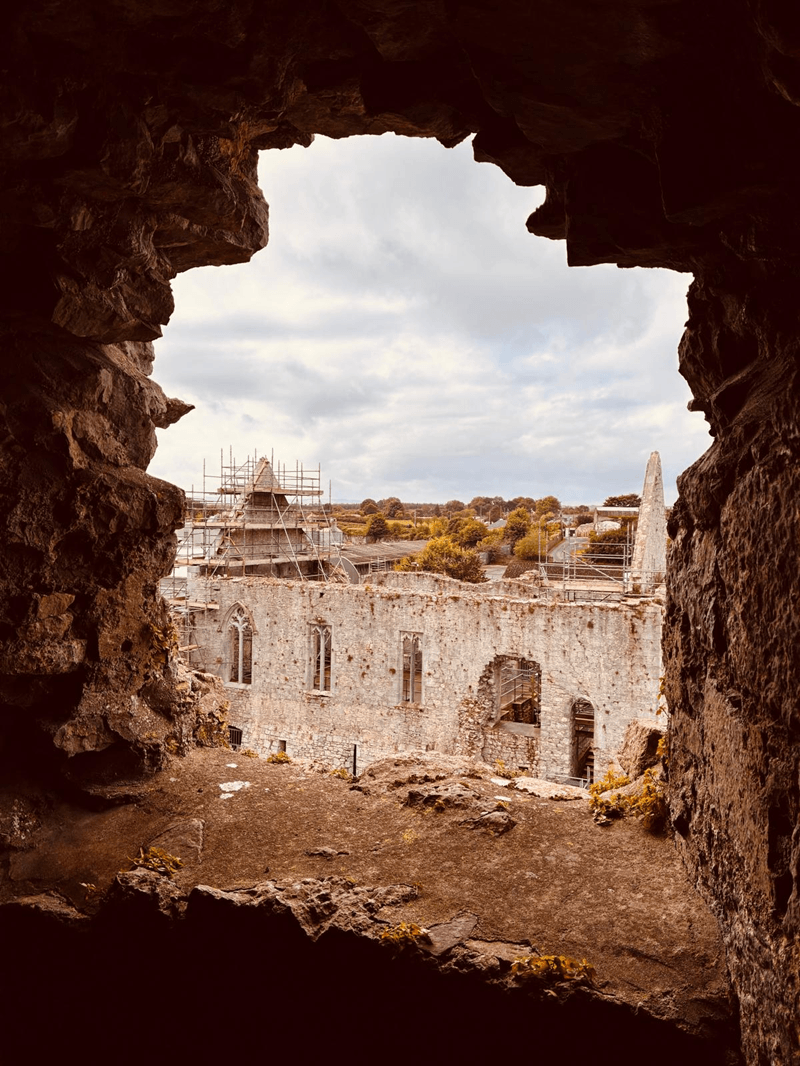
The most remarkable surviving building is the Great Hall, traditionally known as the Banqueting Hall or Halla Mór. Its origins are medieval, but the building was extensively remodelled during the fifteenth century. It is one of the finest surviving examples of a medieval secular hall in Ireland. Its large windows, Gothic architectural details, high gables and elaborate stonework demonstrate that the castle was intended not merely as a military fortress but as a residence appropriate to one of the most powerful noble families in Ireland [2].
The hall also illustrates the political role of the castle. It was a place for feasting and hospitality, but could also serve as the setting for political assemblies, the administration of justice and negotiations. The delicate window tracery becomes increasingly elaborate towards the dais, where the earl, countess and other dignitaries would have held court. The combination of impressive domestic architecture and defensive surroundings is characteristic of the Desmonds' principal residences during the later Middle Ages [5].
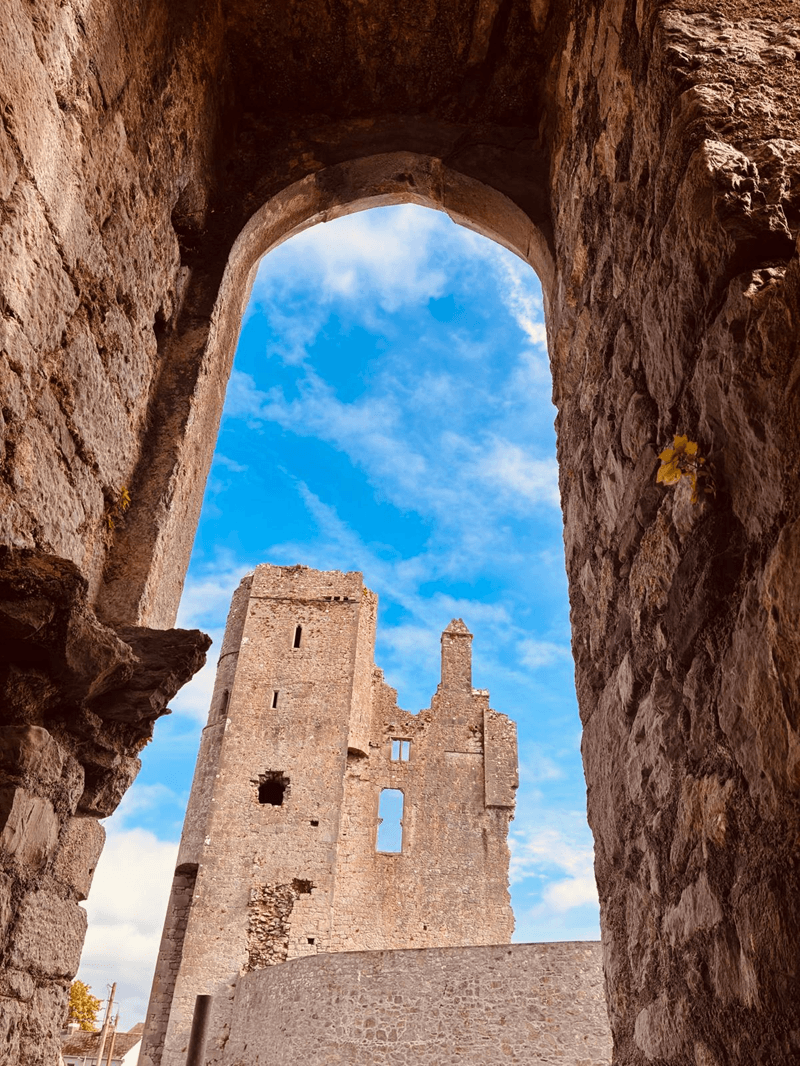
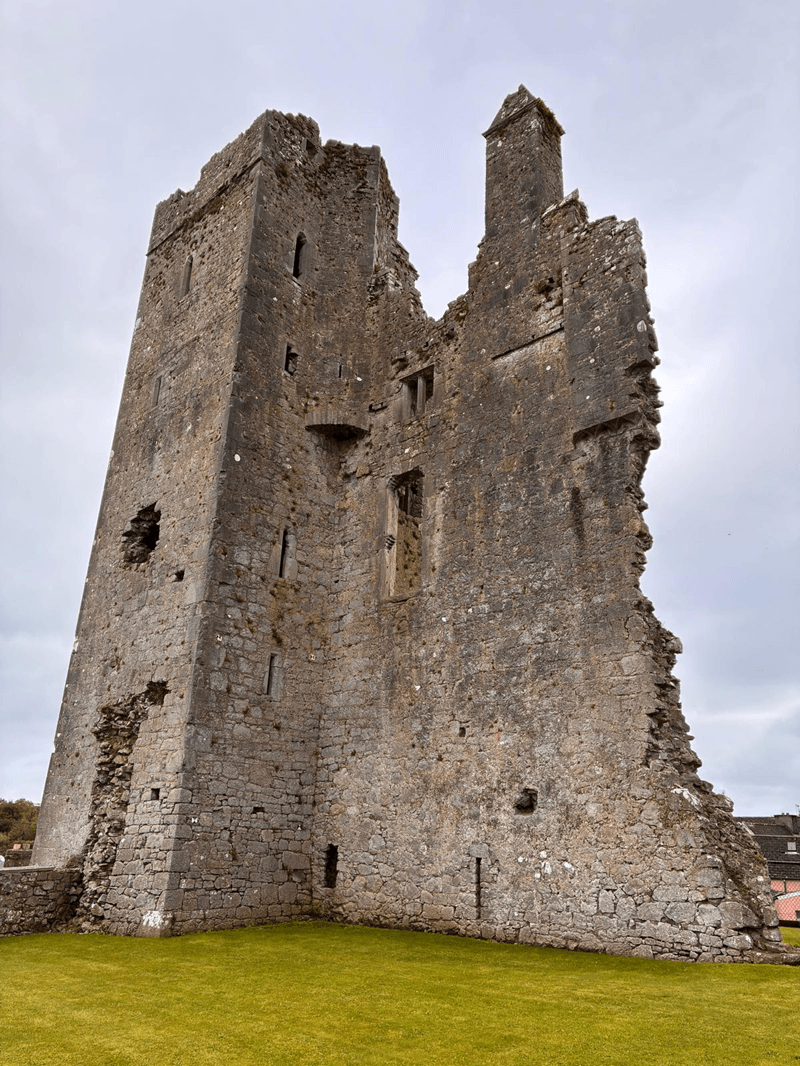
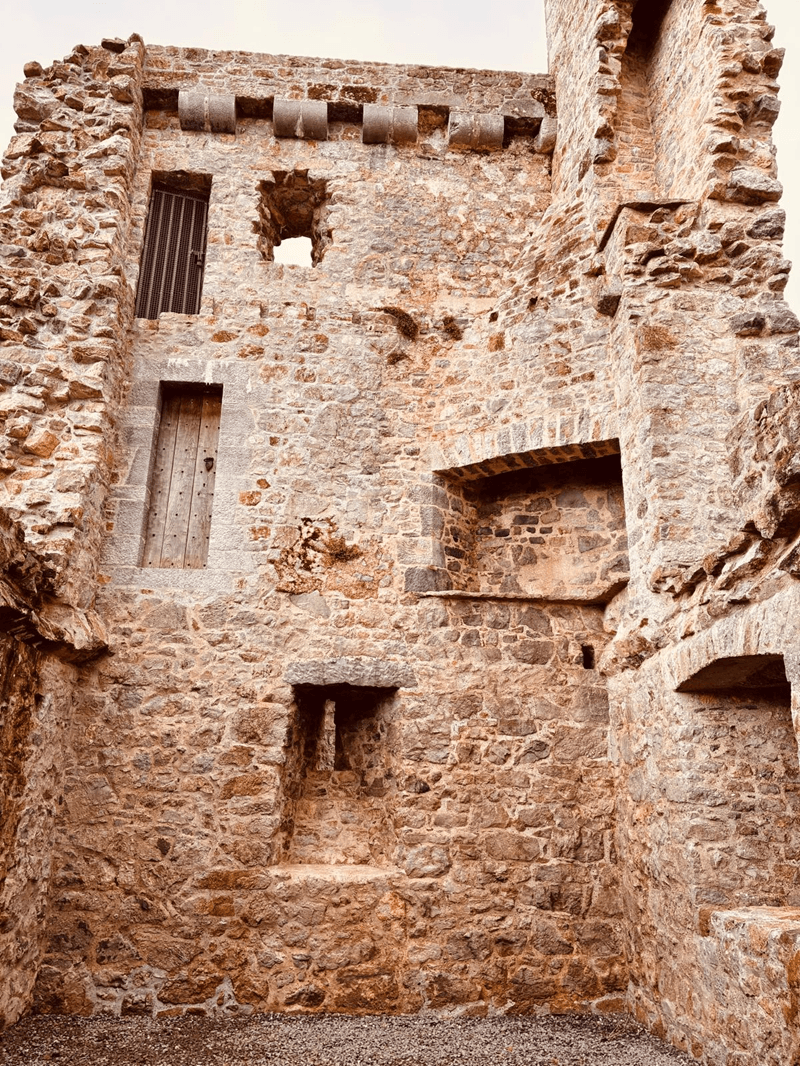
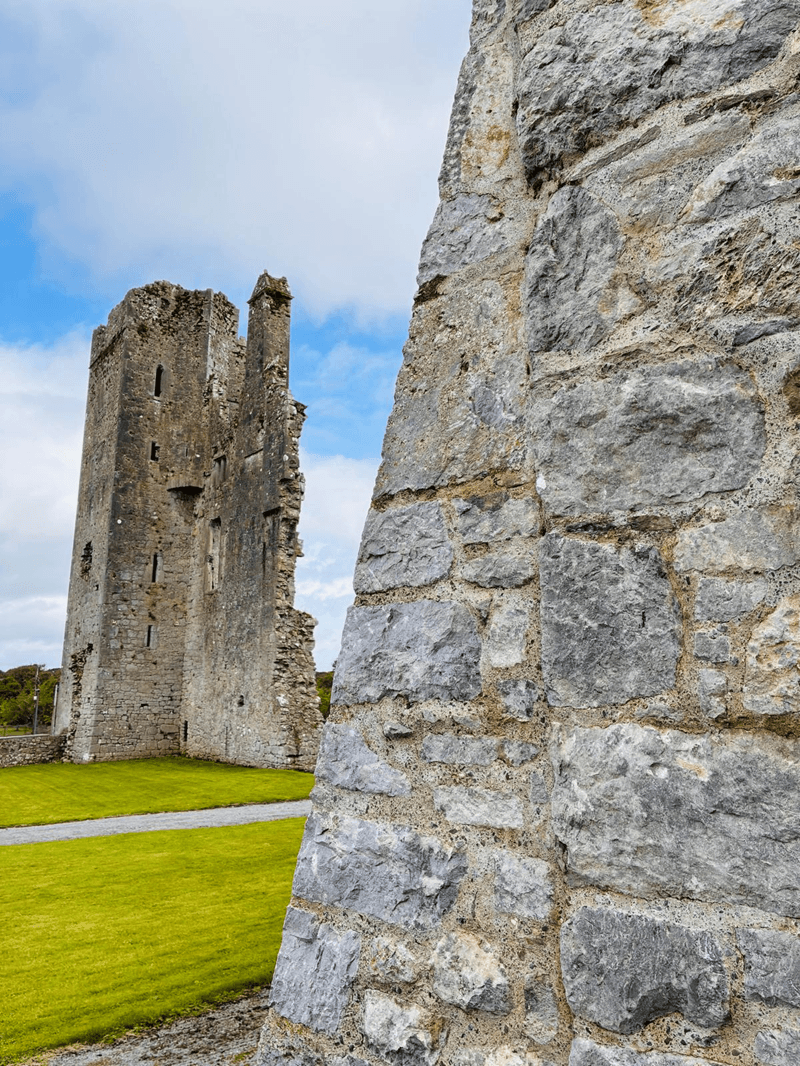
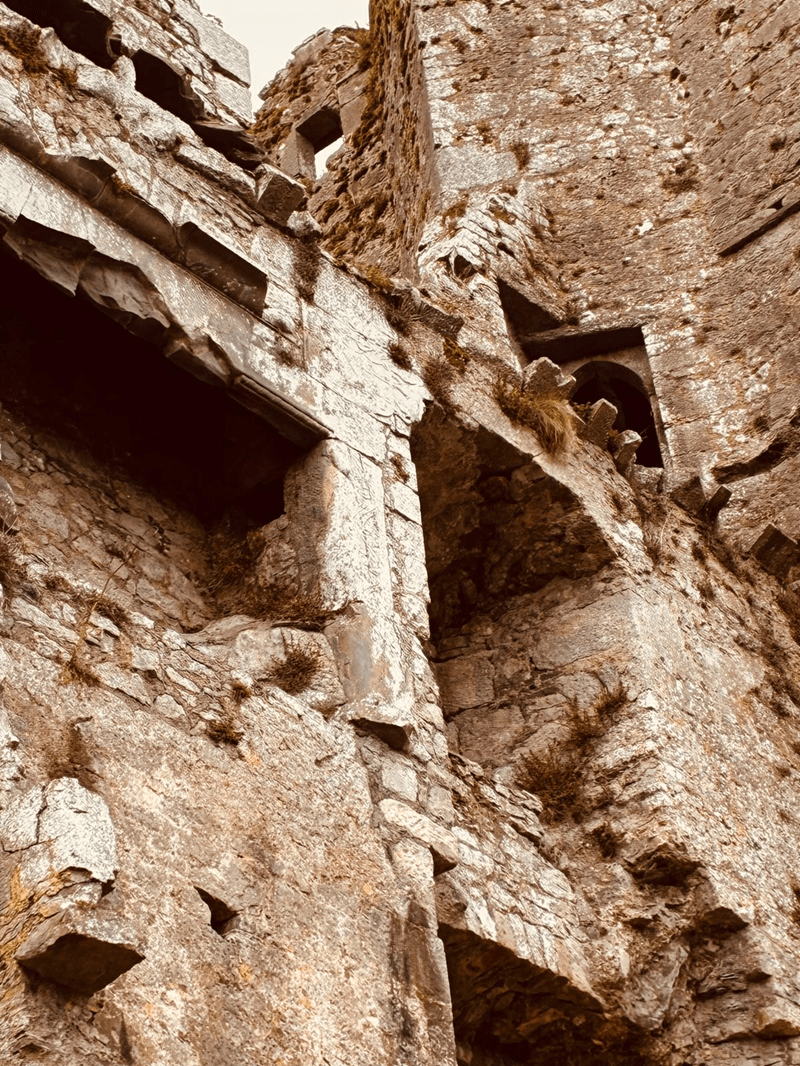
Other surviving elements preserve earlier phases of the fortress. A substantial tower at the southern end of the inner ward and sections of the curtain wall have thirteenth-century origins, although both were subsequently altered. At the northern end of the inner ward are the remains of a large sixteenth-century building, showing that construction and adaptation continued even after the great fifteenth-century rebuilding programme [1].
Askeaton and France
The importance of Askeaton extended beyond local and regional politics. In 1523 the castle became the setting for an extraordinary episode in Irish-European diplomacy. James FitzGerald, tenth Earl of Desmond, met French agents representing François I at Askeaton and reached an agreement with them. Desmond undertook to oppose Henry VIII, while the French side offered support and promised assistance to the Geraldines and their allies. The episode formed part of the early attempts by powerful Anglo-Irish Geraldines to establish relations with France as a counterweight to English authority [6].
The negotiations took place against the background of the wider European conflict between François I and Henry VIII. The French king was interested in exploiting opposition to England wherever it could be found, while Desmond sought external support for the considerable autonomy enjoyed by his lordship. The episode illustrates the extent to which Askeaton had become a centre of international as well as Munster politics [7].
The Earl of Desmond and the Elizabethan Wars
By the second half of the sixteenth century, the relationship between the Desmond Geraldines and the English Crown had become increasingly strained. Gerald FitzGerald, 15th Earl of Desmond, inherited a powerful but increasingly threatened lordship. The Tudor government was determined to extend effective royal authority throughout Munster, while the Desmonds and their allies sought to preserve their traditional political independence [8].
Askeaton was at the centre of this increasingly dangerous political world. The castle was the principal residence of the Desmond family, and Gerald's second wife, Eleanor Butler, lived there with him. In 1579 the castle became associated with the arrival of Bishop Patrick O'Healy and the Franciscan friar Conn O'Rourke, who were entertained by Eleanor for three days before their arrest on the road to Limerick. Both men were subsequently executed at Kilmallock and later came to be remembered as Catholic martyrs [9], [10].
 Two years earlier, in 1577, Askeaton had briefly held another remarkable prisoner: Gráinne O’Malley, better known as Grace O’Malley or Granuaile. Captured during her conflict with the Earl of Desmond, she was brought to Askeaton and imprisoned there before being transferred to Limerick and eventually to Dublin Castle [11].
The strategic position of Askeaton made the castle a particular concern for the English authorities. Its location on the Deel, close to the Shannon Estuary, gave it considerable military value and made it an important base from which the Desmonds could communicate with their allies and control movement through the region. When Sir Nicholas Malby came against Askeaton on 10 October 1579, Gerald FitzGerald was at the castle. Malby lacked the artillery necessary to reduce the fortress and therefore failed to take it [12].
Malby's failure to capture the castle was followed by a brutal attack on the surrounding Desmond presence. He desecrated the FitzGerald family tombs, scattering the remains of members of the family outside the castle. The incident greatly inflamed an already bitter conflict and contributed to the escalation of the Second Desmond Rebellion [12].
The castle was not taken in 1579, but its position became increasingly difficult to maintain. In 1580 the fall of Carrigafoyle Castle demonstrated the destructive power of English artillery and prompted the abandonment of several important Desmond strongholds. Askeaton's defenders withdrew after placing gunpowder beneath parts of the fortress. The resulting explosion damaged the castle but did not destroy it completely, and English forces took possession of the remaining structures [13], [14].
The Plantation and the Geraldine Revival
The defeat of the Desmond rebellion brought a fundamental change to Askeaton. The Desmond lands were confiscated and redistributed, and the Crown sought to establish a new political and social order in Munster. The castle and surrounding lands subsequently became associated with English interests, including the Berkeley family, as the government attempted to consolidate its control over the region [1].
The new order did not eliminate opposition. During the renewed Geraldine resistance of the late 1590s, James FitzThomas FitzGerald, later known as the “Súgán Earl of Desmond”, emerged as a claimant to the Desmond title. Askeaton once again became strategically important because the castle remained in government hands while the surrounding countryside was increasingly affected by the rebellion [15].
In 1599 Robert Devereux, 2nd Earl of Essex, led a major English expedition through Munster. After the prolonged siege of Cahir, Essex moved through Limerick and into Desmond, travelling by way of Adare and Askeaton. The campaign demonstrated that Askeaton still occupied an important position within the military geography of western Munster [16].
The Seventeenth Century
Askeaton continued to have military importance during the turbulent decades that followed. In the early seventeenth century the town was incorporated and developed a more formal municipal structure. The castle remained an important landmark and strategic position within the settlement, even though its role was increasingly shaped by the changing political order established after the Desmond wars [1].
The castle again became directly involved in warfare during the Confederate period. In 1642 a garrison was established at Askeaton, and Irish Confederate forces subsequently besieged the castle. The siege is unusually well documented in the surviving manuscript material of the British Library, which includes an account of the events, the articles of capitulation and a list of the principal rebels involved [17].
The final destruction of the fortress followed during the Cromwellian conquest of Ireland. By the middle of the seventeenth century Askeaton had lost the political importance that it had possessed under the Desmonds, and the military value of the old castle had declined. Its fortifications were subsequently dismantled, bringing to an end its long career as one of the principal strongholds of western Munster [1].
From Fortress to Ruin
The destruction of the castle did not mean the disappearance of the site from the history of Askeaton. The town remained a market and administrative centre, while the ruined fortress became an increasingly prominent feature of its landscape. The surviving walls continued to be associated with the great Desmond dynasty and with the political struggles that had shaped Munster between the medieval and early modern periods [1].
Another building within the castle complex belongs to a much later period. The red-brick structure known as the Hellfire Club dates from the early eighteenth century and became associated with the notorious gentlemen's clubs of the period. Although it has no medieval connection with the castle, its survival within the same enclosure adds another layer to the site's long history [2].
 The importance of Askeaton Castle was increasingly recognised as antiquarian and archaeological interest in Ireland developed during the nineteenth and twentieth centuries. Studies by Thomas Johnson Westropp and other antiquaries recorded the surviving structures, historical traditions and documentary evidence, helping to establish the importance of the castle as one of the principal medieval sites of County Limerick [18].
The castle is now a National Monument in State care and is managed by the Office of Public Works. Extensive conservation work was undertaken over more than a decade, concentrating on stabilising the surviving masonry and protecting vulnerable sections of the complex. The work required particularly careful intervention because parts of the monument stand directly within the river environment [19].
Following the restoration programme, Askeaton Castle reopened to visitors in 2020. The conservation work allowed the public to experience the surviving medieval architecture at close range while preserving the remains for future generations. Archaeological monitoring has continued alongside conservation, and recent investigations have added further information about the castle's entrance and successive phases of development [4], [19].
Today, the ruins of Askeaton Castle preserve an unusually rich record of the evolution of an Irish stronghold. The surviving thirteenth-century masonry, the great fifteenth-century hall and towers, the later domestic and defensive additions, and the scars left by the wars of the sixteenth and seventeenth centuries all belong to different chapters of the same story. More than simply a ruined castle, Askeaton represents the transformation of power in Munster from the Anglo-Norman conquest, through the rise of the Desmond Geraldines and their international ambitions, to the Tudor and Cromwellian destruction of the political world in which the fortress had once stood at the centre.
References
- [1] National Monuments Service - County Limerick and Limerick City Urban Archaeological Survey, Archaeological Survey of Ireland
- [2] Office of Public Works - Heritage Ireland - Askeaton Castle
- [3] Dictionary of Irish Biography - FitzGerald, James fitz Gerald
- [4] National Monuments Service - Excavations.ie - 2023:586 – Askeaton Castle, Limerick
- [5] Office of Public Works - Heritage Ireland - Askeaton Castle – Highlights
- [6] Richard Bagwell - Ireland under the Tudors
- [7] Mary Ann Lyons, ‘Vain imagination’: the French dimension to Geraldine intrigue, 1523–1539, in Franco-Irish Relations, 1500–1610
- [8] Dictionary of Irish Biography - FitzGerald, Gerald fitz James
- [9] Dictionary of Irish Biography - O'Healy, Patrick
- [10] Dictionary of Irish Biography - O'Rourke, Conn
- [11] Dictionary of Irish Biography - Gráinne O’Malley (Grace) (‘Granuaile’)
- [12] Dictionary of Irish Biography - Malby, Sir Nicholas
- [13] Office of Public Works - Heritage Ireland - Carrigafoyle Castle
- [14] Library Ireland - Askeaton, a market and post-town - Samuel Lewis, A Topographical Dictionary of Ireland (1837)
- [15] Dictionary of Irish Biography - FitzGerald, James fitz Thomas
- [16] Library Ireland - Robert Devereux, 2nd Earl of Essex - Alfred Wenn, A Concise Dictionary of Irish Biography (1878)
- [17] British Library Archives and Manuscripts - Sloane MS 1008 – Askeaton Castle, 1642
- [18] National Library of Ireland - Thomas Johnson Westropp, Notes on Askeaton, Co. Limerick, Journal of the Royal Society of Antiquaries of Ireland
- [19] RTÉ News - Desmond Castle reopening to public after restoration, 6 September 2020
Other useful links
- Limerick.ie - The Medieval Village of Askeaton
- Heritage Ireland - Askeaton Franciscan Friary
- Limerick.ie - Askeaton History & Heritage
- Discover Ireland - Askeaton Castle
- Wikipedia - Maurice FitzGerald, 1st Earl of Desmond
- Wikipedia - James FitzGerald, 10th Earl of Desmond
- Wikipedia - Francis I of France
- Wikipedia - Henry VIII
- Wikipedia - Gerald FitzGerald, 15th Earl of Desmond
- Wikipedia - Eleanor Butler, Countess of Desmond
- Wikipedia - Nicholas Malby
- Wikipedia - Second Desmond Rebellion
- Wikipedia - James FitzThomas FitzGerald
- Wikipedia - Robert Devereux, 2nd Earl of Essex
- Wikipedia - Confederate Ireland
- National Army Museum - Oliver Cromwell: Lord Protector
- Wikipedia - Thomas Johnson Westropp
- Wikipedia - Gráinne O’Malley (Grace O’Malley)
- National Maritime Museum of Ireland - Grace O’Malley