History
Introduction
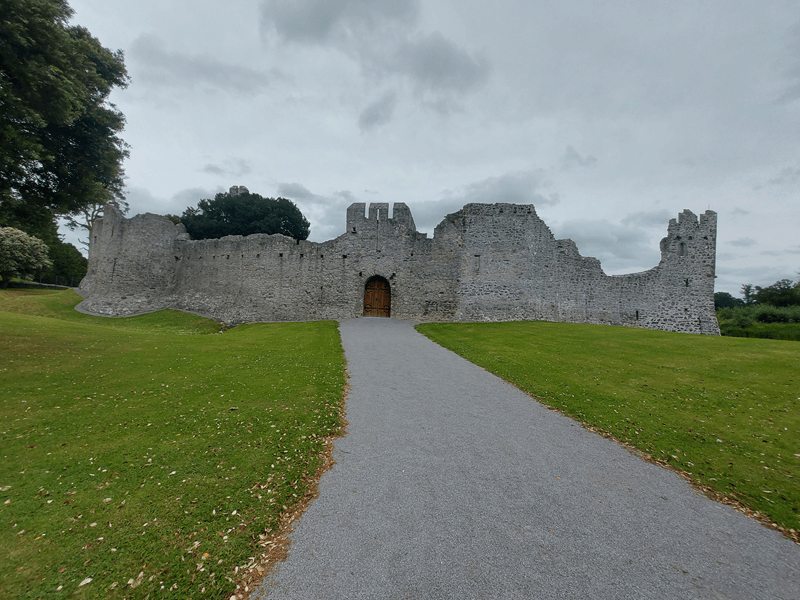
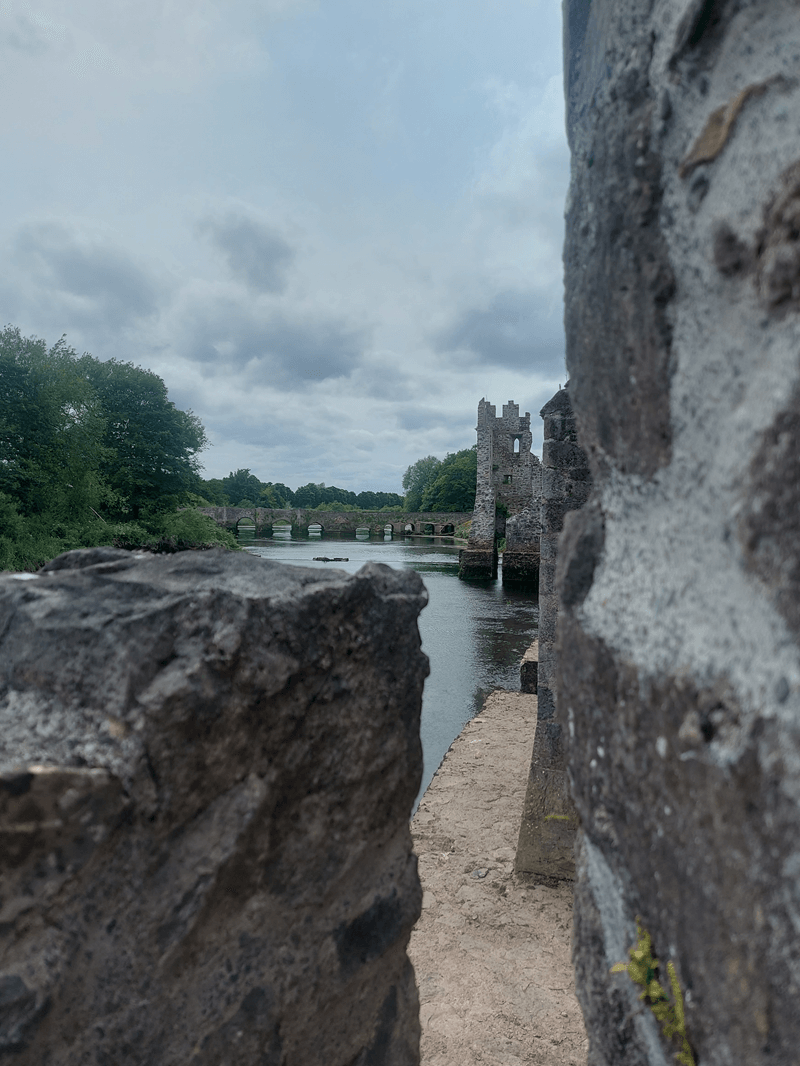
Adare Castle, also known as Desmond Castle, stands on the northern bank of the River Maigue at Adare in County Limerick. Its position was of considerable strategic importance: the castle stood beside a crossing of the Maigue and from here its lords could control movement along the river and traffic travelling towards or from the Shannon Estuary [1].
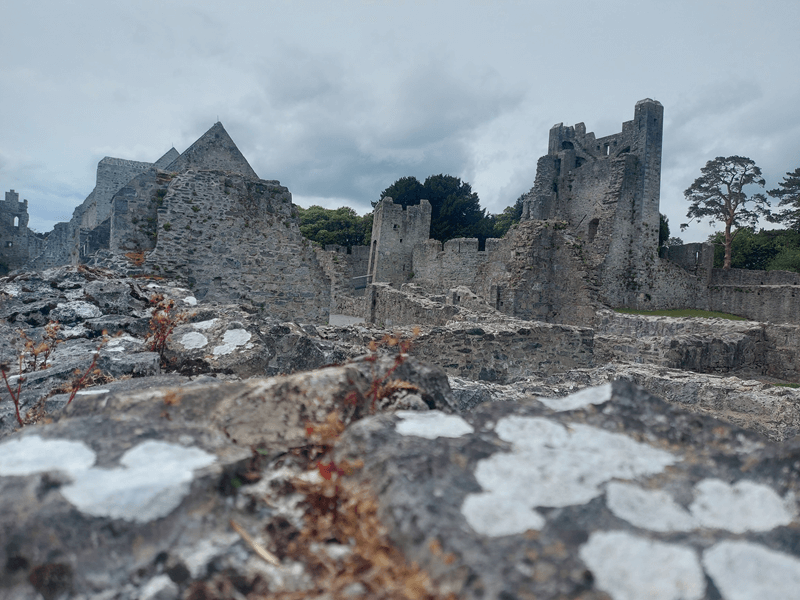
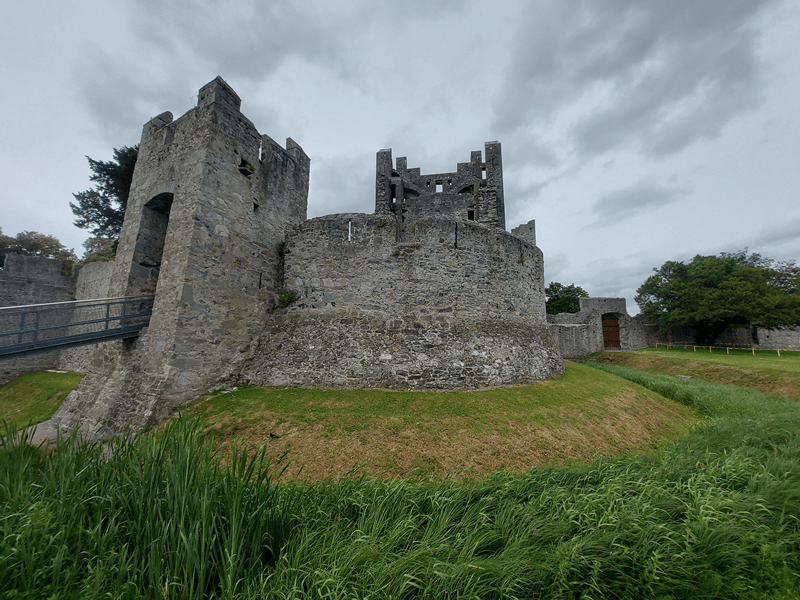
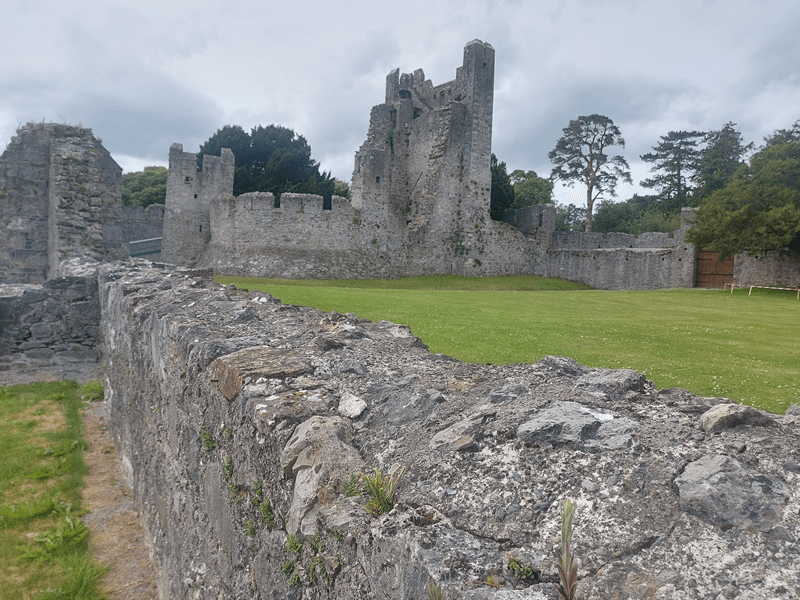
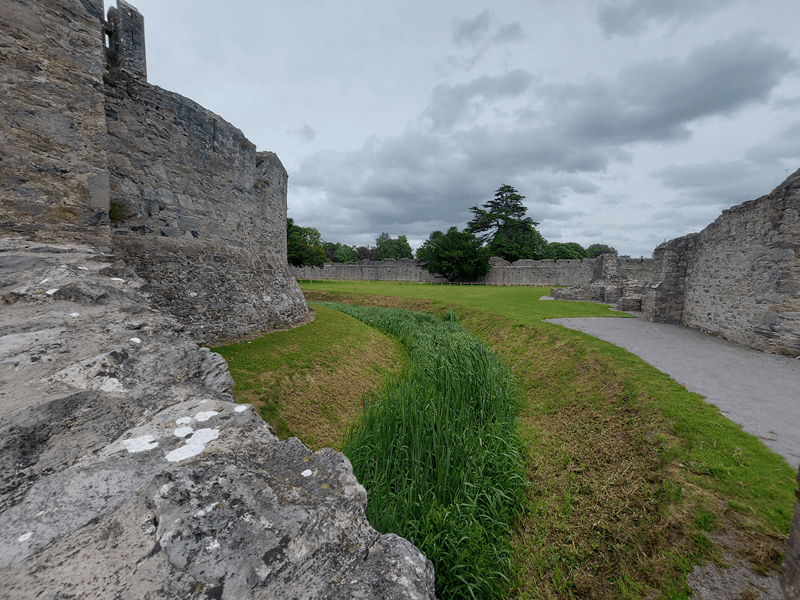
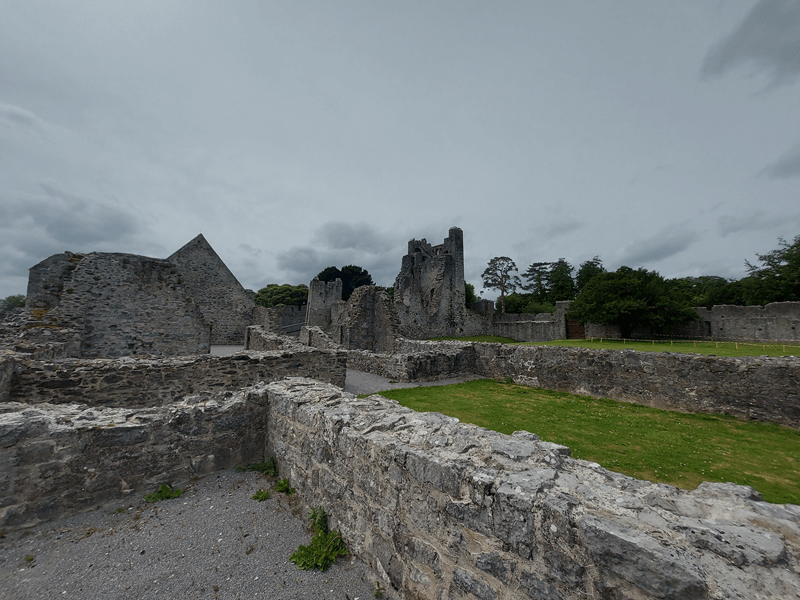
The castle that survives today is the remains of a large Anglo-Norman fortified complex which developed over several centuries. At its heart was a substantial square keep, surrounded by an inner ward and protected by a moat or fosse. Beyond this was an outer ward containing halls, kitchens, domestic buildings and other structures necessary for the life of a powerful medieval household [2], [3].
Although the ruins are now surrounded by the picturesque village of Adare, the castle's history is one of warfare, political ambition, changing ownership and repeated rebuilding. It was associated first with the Anglo-Norman de Marisco family, then for centuries with the powerful FitzGerald Earls of Kildare, later with the FitzGerald Earls of Desmond, and eventually with the Quin family and the Earls of Dunraven [2].
The origins of Adare Castle
The origins of Adare Castle are not entirely straightforward, and there has been considerable debate among historians and archaeologists about the earliest occupation of the site.
The traditional account attributes the construction of the castle to Geoffrey de Marisco, the powerful Anglo-Norman Justiciar of Ireland. Historical references associate de Marisco with a castle at Adare around 1226 [2], [3].
Archaeological investigation, however, suggests that the story may be somewhat older. Architectural evidence indicates that the earliest masonry castle may have been founded around 1200, several decades earlier than the traditional 1226 date [3]. The first phase of the castle therefore appears to belong to the early years of the thirteenth century, during the period when Anglo-Norman lordship was becoming firmly established throughout much of Ireland.
The name Adare derives from the Irish Áth Dara, generally translated as "ford of the oak", reflecting the importance of the river crossing [2], [4]. The location was particularly suitable for a fortified settlement because the River Maigue provided both a natural defensive feature and an important means of communication.
There has also been a long-running debate about whether the Norman castle was built upon an earlier Irish fortification. One tradition claimed that Domnall Mór Ua Briain, King of Limerick and Thomond from 1168 to 1194, built a "Black Castle" at Adare, together with a great hall to its south. This account appears in later Irish historical material, but it should be regarded as a tradition rather than an established fact [2].
Archaeologists have also debated whether Adare Castle was constructed on an earlier ringfort or ringwork. Excavations have not provided a simple answer to the question. Finds from the site include an early medieval baluster-headed ringed pin and part of a decorated rotary quern, demonstrating activity in the vicinity before the surviving medieval castle, but these objects do not by themselves prove that an earlier fort occupied exactly the same site [5].
The archaeological evidence therefore leaves us with an intriguing possibility: there may have been earlier activity at Adare before the Anglo-Norman masonry castle was constructed, but the exact nature of that occupation remains uncertain [5].
Geoffrey de Marisco and the Anglo-Norman settlement
Geoffrey de Marisco was one of the most powerful Anglo-Norman figures in Ireland. He served as Justiciar of Ireland during the reigns of King John and Henry III and controlled extensive lands and interests within the country. The construction of Adare Castle should be understood within the wider expansion of Anglo-Norman settlement and fortification that took place during this period [2], [3].
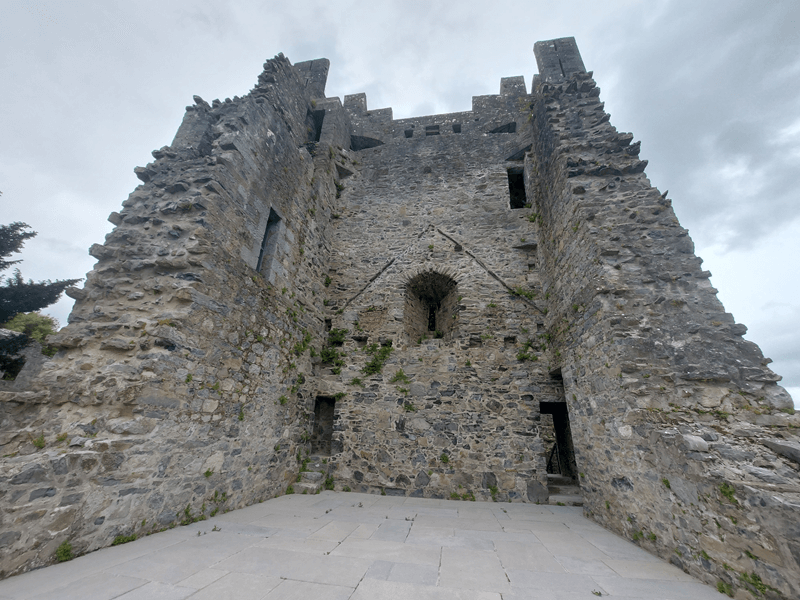
The earliest castle would probably have been very different from the picturesque ruins visible today. The initial complex appears to have centred upon a substantial square tower or keep, accompanied by a hall and defensive enclosure. Over subsequent generations the castle was enlarged and transformed into a much more complex fortified residence [3], [6].
By 1226, Geoffrey de Marisco held the manor of Adare and had received royal permission to hold an annual fair there. This is an important date in the history of the settlement, although it should not automatically be regarded as the date when the stone castle was constructed. Archaeological evidence points towards an earlier foundation, probably around 1200 [2], [3].
The castle's location beside the Maigue was fundamental to its importance. The river was tidal as far upstream as Adare, and the castle occupied a commanding position beside the crossing. Archaeological investigations have found evidence of medieval activity along the river itself, including a small mooring area and part of a stone pier, together with medieval pottery, wooden objects and an armour-piercing arrowhead [4].
Adare Castle was therefore connected not only with the roads and land routes around the town but also with the river.
The FitzGeralds arrive at Adare
The de Marisco period did not last indefinitely. After Geoffrey de Marisco's fall from royal favour, his lands were redistributed, and Adare eventually passed into the hands of the FitzGerald family.
In 1266, the manor of Adare was granted to Sir Maurice FitzGerald and his wife, Agnes de Valence [2]. From this point the castle became closely associated with the FitzGeralds, and particularly with the branch of the family that would become the Earls of Kildare.
The FitzGeralds were to dominate the history of Adare for centuries. With only brief interruptions, the Kildare FitzGeralds retained the manor until the upheavals of the sixteenth century [2].
During their ownership the castle was gradually transformed from an early Anglo-Norman fortress into a much larger fortified residence.
The medieval castle
The surviving ruins can give only a partial impression of the scale and complexity of medieval Adare Castle.
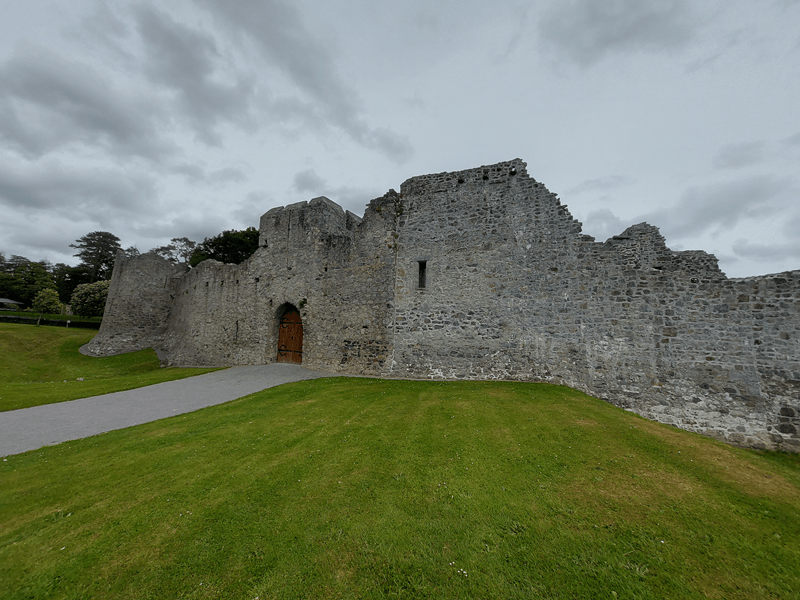
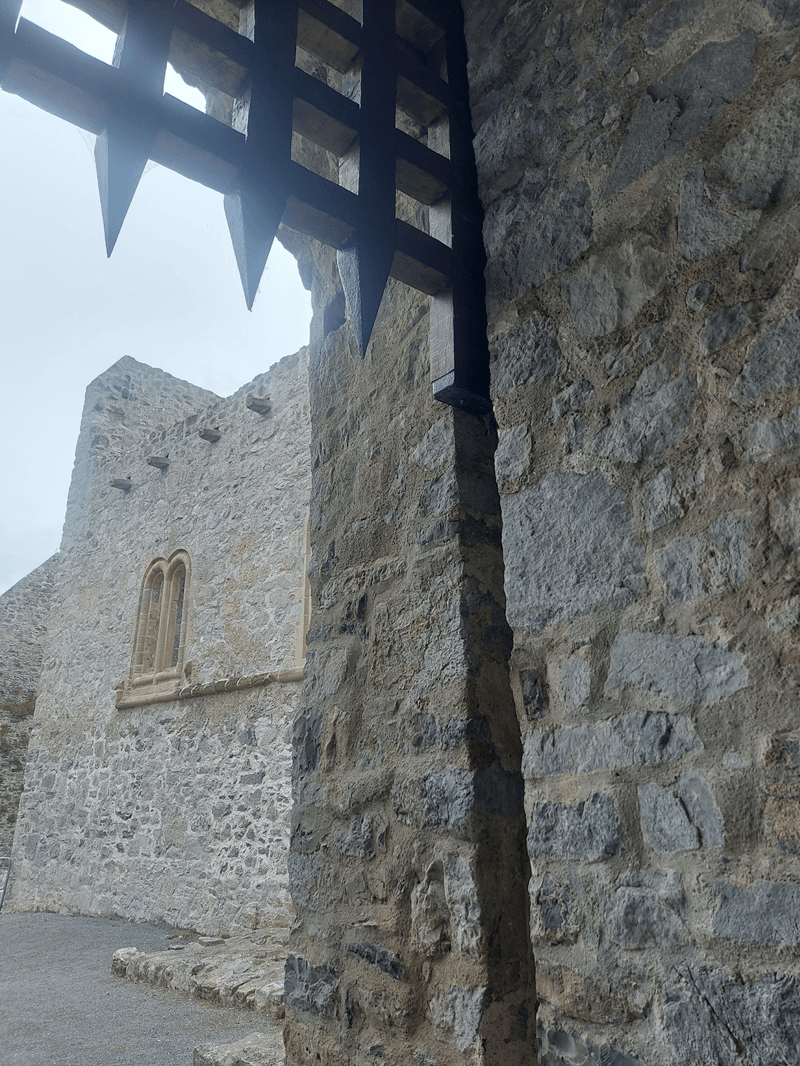
The castle consisted of a keep within an inner ward, which was itself protected by an outer ward. Defensive fosses or moats surrounded important parts of the complex, while the River Maigue provided a natural defensive boundary along the southern side. The principal entrance to the outer ward was on the western side and was protected by a gatehouse incorporating a rear portcullis [3].
The inner ward had its own defensive arrangements, including a gate tower and drawbridge. The archaeological investigation of the drawbridge pit in 2001 revealed important evidence about the defensive system and the way the entrance was constructed [7].
The castle was not merely a military installation. A medieval lord required accommodation, dining halls, kitchens, storage rooms and service areas, and excavations have revealed evidence of all these functions.
One of the most important discoveries has been the evidence for two major halls. The earlier hall stood towards the western side of the complex, while the larger later hall was constructed further east [3], [8].
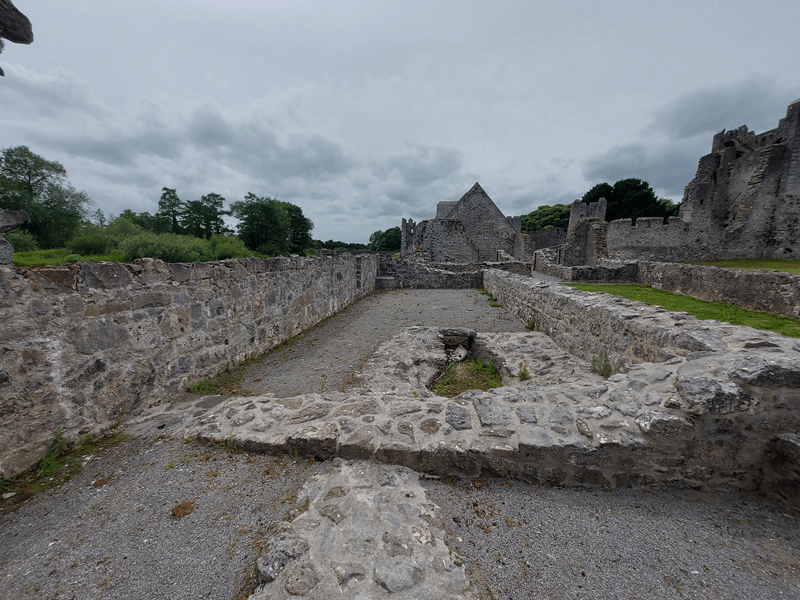
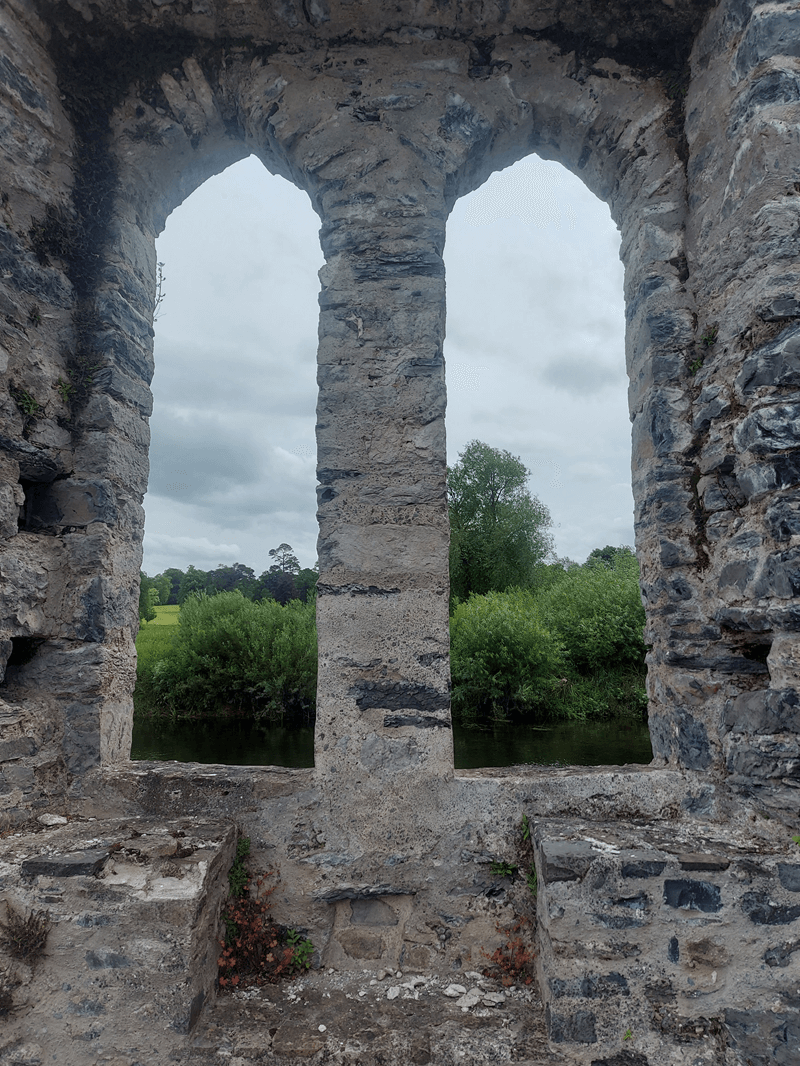
The Great Hall was a substantial rectangular building beside the river. Its surviving remains include evidence of windows, internal cobbled surfaces, drainage and an intramural spiral staircase. Archaeologists also found traces of a hearth and charred plant remains including oats, wheat, barley, peas, beans and hazelnuts [8].
These discoveries provide a glimpse into the everyday life of the medieval castle. The Great Hall was not simply an impressive architectural space; it was a working part of the household where food was prepared and consumed, people gathered and the business of the lordship was conducted.
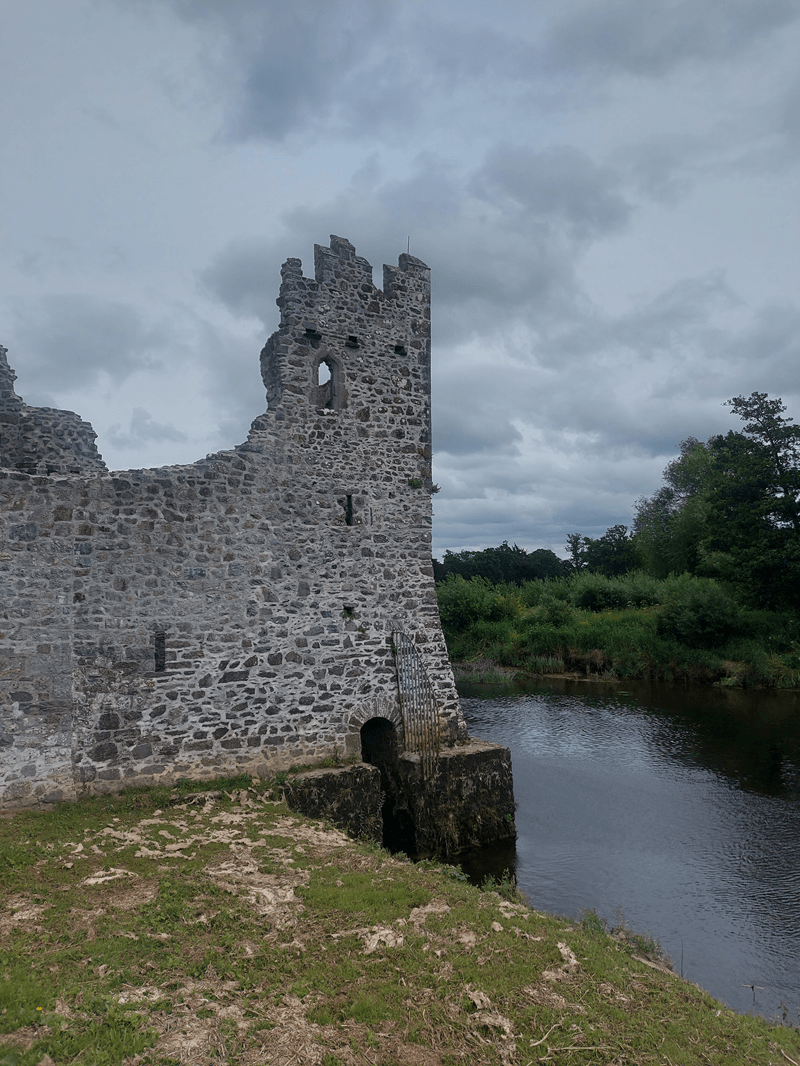
The later aisled hall was another substantial building on the southern side of the complex, close to the river. It had an entrance porch, internal pillars and a river gate providing direct access towards the Maigue [8].
The presence of a river gate is particularly interesting. It demonstrates once again how closely the castle was connected with the river and suggests that the Maigue was an integral part of the castle's communications and daily life.
The fourteenth century
The castle continued to evolve during the fourteenth century.
A royal inquisition or survey of the castle was undertaken in 1331, and repairs were recorded in 1334 [2]. The period also saw substantial development of the castle and the wider town of Adare.
The second Earl of Kildare is traditionally associated with major works at the castle around 1326. Some of the larger structures visible today may relate to this period, although archaeological evidence demonstrates that the castle continued to be modified long afterwards [2], [6].
The larger hall on the southern side of the complex may have been added during this phase. It was an imposing building positioned directly beside the river, with large windows and a design suited not only to domestic life but also to the reception and entertainment of important visitors [6].
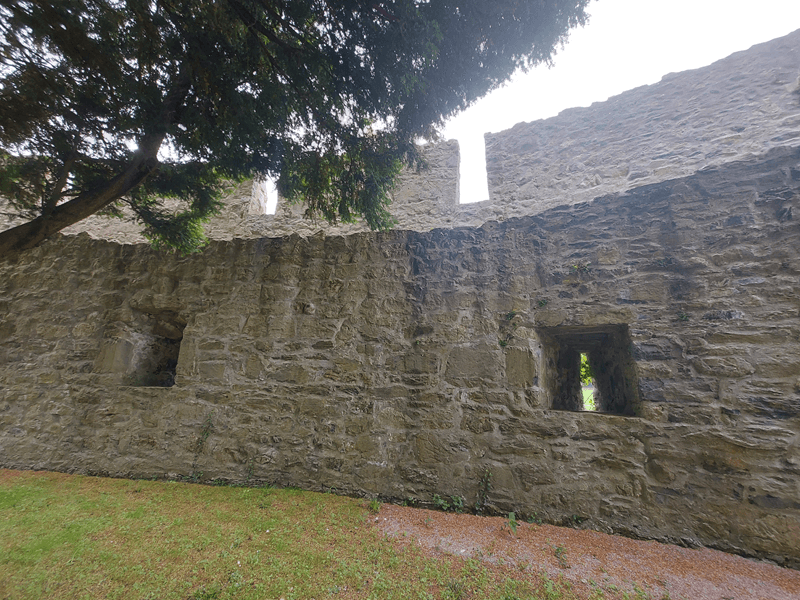
The castle's defences were also strengthened. Curtain walls replaced or supplemented earlier timber defences, while the inner and outer fosses provided additional protection [6].
The town itself was developing around the castle and the river crossing. Adare became an important centre of the surrounding manor, and the FitzGeralds were responsible for much of its medieval development.
War and destruction in the fourteenth century
Adare's strategic importance also made it vulnerable during periods of conflict.
In 1376, a royal writ referred to the recent burning and destruction of Adare by the "Irish enemy". The authorities attempted to encourage the rebuilding and repopulation of the settlement by redirecting certain payments and customs [8].
The episode illustrates the difficult position of Anglo-Norman settlements such as Adare. Although the castle itself was a formidable structure, the surrounding town and countryside could be attacked and devastated during periods of conflict.
The castle survived these disturbances and continued as an important FitzGerald stronghold.
The fifteenth century
The fifteenth century brought further changes to Adare Castle.
In 1464, the castle was burned during an attack associated with Turlough O'Brien. It was subsequently repaired [2].
This period also saw further architectural development. Parts of the surviving outer curtain wall are thought to be largely fifteenth-century in date, while the central keep appears to have been remodelled during the later medieval period [6].
The keep is particularly interesting because its present appearance does not necessarily represent its original medieval form. Archaeological and architectural evidence indicates that the tower was altered and enlarged over time [6].
Adare was also becoming an important religious centre. The medieval town contained several religious foundations, including the Augustinian, Trinitarian and Franciscan houses. The Franciscan friary was founded in 1464, adding another important institution to the settlement surrounding the castle [8].
The castle therefore stood at the centre of a complex medieval landscape in which political power, religion, trade and military strength were closely interconnected.
The Kildare FitzGeralds and the Tudor period
By the beginning of the sixteenth century, the FitzGeralds of Kildare were among the most powerful families in Ireland.
The castle was closely associated with the Earls of Kildare, but their position became increasingly precarious as the English Crown attempted to impose greater control over Ireland.
The crisis came with the rebellion of Silken Thomas, the young Earl of Kildare, in 1534. The rebellion failed, and the Kildare family's estates were forfeited to the Crown. Adare Castle consequently passed out of their control [2], [8].
In 1537, the manor of Adare was leased to the FitzGeralds of Desmond [2].
This transfer is crucial to understanding the castle's modern name.
Although today the castle is officially known as Desmond Castle, Adare, it was not originally a castle of the Earls of Desmond. For centuries it had been associated primarily with the FitzGerald Earls of Kildare. The connection with the Desmond branch came much later, in the sixteenth century [2].
In 2020, the Office of Public Works announced that it would officially adopt the name "Desmond Castle, Adare", noting the site's historical association with the FitzGerald Earls of Desmond [9].
The Desmond Rebellions
The association with the Desmond FitzGeralds brought Adare Castle into one of the most violent periods in Irish history.
The Second Desmond Rebellion, which began in 1579, was part of a wider conflict between the Crown and the FitzGerald Earl of Desmond and his allies. Adare's strategic location made the castle an important military position for English forces seeking to control Munster [1], [2].
In 1578, the castle was captured by English forces following a siege traditionally described as lasting eleven days. It was subsequently garrisoned by English troops under Captain Carew [10].
The Desmond forces attempted to recover the stronghold. Sir John Desmond attacked the castle but was repulsed by its defenders. In 1581, the castle was again besieged, this time by the Earls of Desmond and Kerry and their forces [10].
The contemporary and later accounts of these events describe fierce fighting around the castle. The English garrison was eventually overwhelmed, but English forces under Colonel Zouch marched from Cork to relieve it. By the time Zouch arrived, the garrison had been defeated, but the relieving force engaged the besieging army and subsequently recovered the castle [10].
The events demonstrate just how valuable Adare Castle was considered by both sides. Whoever controlled the castle possessed an important stronghold on the route through western Limerick and could use it as a base for operations in the surrounding countryside.
The fighting also undoubtedly affected the fabric of the medieval buildings.
The Nine Years' War
The castle was drawn into another major conflict only a few years later.
In 1598, during the Nine Years' War, Adare Castle was held by English forces but was captured by Irish forces [2].
By this stage the castle had already endured repeated attacks and changes of garrison. Its military significance remained considerable, but the nature of warfare was changing. Artillery and firearms were increasingly important, while castles originally designed for medieval warfare were becoming progressively less effective as defensive structures.
In 1600, the English retook Adare Castle. Later historical accounts describe the garrison suffering severe shortages during the fighting, including a lack of food and difficulty obtaining water. One account states that water was obtained through a subterranean passage excavated towards the river [10].
Whether every detail of this later account can be independently verified is difficult to establish, but it illustrates the desperate conditions associated with the castle's final period as an active military stronghold.
The rebellion of 1641
Adare Castle once again found itself in the middle of conflict during the 1641 Rebellion.
The castle was seized and held by insurgent forces. They were subsequently driven out, and the castle was garrisoned by Lord Castlehaven [2].
The events of the 1640s formed part of the much wider Wars of the Three Kingdoms and the struggle for control of Ireland.
By now, however, the medieval castle was approaching the end of its military life.
Cromwellian destruction
The final decisive chapter in the castle's military history came during the Cromwellian conquest of Ireland.
In 1657, Cromwellian or Parliamentary forces ordered the castle to be dismantled [1], [2].
This effectively ended Adare Castle's role as a military stronghold. The destruction explains much of the ruinous appearance of the complex today.
Local tradition later maintained that the castle was battered by cannon from a hill on the opposite side of the River Maigue, although this should be treated as local tradition rather than established archaeological fact [11].
After the dismantling of the castle, it was no longer maintained as a functioning fortress. Its surviving walls and buildings gradually became ruins, although parts of the complex continued to be incorporated into the landscape and estate.
The Quin family
A new chapter began in 1683, when the manor of Adare was leased to Thady Quin. His descendants would eventually become the Earls of Dunraven and would transform the appearance of Adare in the eighteenth and nineteenth centuries [2].
In 1692, an Act was passed allowing the Earl of Kildare to sell Adare in order to meet financial obligations [2].
The ownership history after the seventeenth century therefore gradually moved away from the medieval FitzGerald dynasties and towards the Quin family.
The ruins of the castle became part of the landscape of the Adare estate rather than a functioning fortress.
The Earls of Dunraven
The later history of Adare Castle is closely connected with the development of Adare Manor and the picturesque village that we know today.
The Quin family eventually became the Earls of Dunraven, and during the nineteenth century the family undertook extensive works throughout the estate.
Some of the surviving fabric of Adare Castle was repaired or rebuilt during this period. The nineteenth-century interventions are important because the ruins visible today are not simply untouched medieval remains. Parts of the castle were reconstructed and consolidated during later restoration campaigns [8].
The Dunravens also undertook major works to the surrounding landscape and village, creating much of the architectural character for which Adare subsequently became famous.
The relationship between the medieval ruins and the nineteenth-century estate is therefore an important part of the site's story. Adare Castle had ceased to be a functioning fortress centuries earlier, but the ruins were incorporated into the romantic landscape created around Adare Manor.
Archaeology at Adare Castle
Modern archaeological excavation has dramatically increased our understanding of the castle.
A major programme of conservation began in 1997, and archaeological excavation was undertaken in advance of and alongside the conservation works. Between 2001 and 2006, six seasons of archaeological investigation were carried out by Eachtra Archaeological Projects [8].
The excavations examined several different parts of the castle, including the drawbridge pit, kitchen, domestic areas, moat, Great Hall and aisled hall [8].
The purpose was not simply to uncover buried objects. Archaeology was required to understand the structure and development of the castle so that conservation work could be undertaken appropriately.
The excavation of the inner drawbridge pit in 2001 provided valuable evidence about the castle's defensive entrance [7].
The following year's work investigated the kitchen and domestic areas. These excavations also recovered evidence which reopened the question of earlier occupation of the site. Among the finds were an early medieval ringed pin and part of a decorated rotary quern [5].
The discovery of these objects does not prove that an early medieval fort stood beneath the castle, but it demonstrates that the area had activity before the construction of the surviving Anglo-Norman masonry [5].
The medieval kitchen
One of the most fascinating aspects of the archaeological investigation is the evidence for the castle's kitchen and domestic life.
Excavation revealed cooking areas, ovens, wells, drains and other features associated with the daily running of the medieval household [8].
Such discoveries are particularly valuable because the surviving walls of a castle tend to tell us about defence and architecture, while the buried archaeological deposits can reveal what life was actually like inside the building.
Food remains and charred plant material provide evidence of crops and food preparation. Finds from the castle included evidence relating to oats, wheat, barley, peas, beans and other plants [8].
These apparently ordinary discoveries help to reconstruct the daily life of the people who lived and worked within Adare Castle.
The Great Hall
The archaeological investigation of the Great Hall has also provided a remarkable amount of information.
The hall contained cobbled floor surfaces, a drain and the remains of an intramural spiral staircase. The base of the staircase survived in the north-east corner of the building, while the remainder had been blocked [8].
Charred plant remains found in the hall included cereals, pulses and hazelnuts, giving further evidence of food preparation and consumption within the castle [8].
The hall's position beside the river is also significant. Large windows opened towards the Maigue, while the substantial architecture reflects the status of the people who occupied and entertained within the building [8], [6].
The Aisled Hall and River Gate
To the east of the Great Hall was the later aisled hall, another major building within the castle complex.
Excavations revealed the remains of walls, stone pillars, cobbled surfaces and an entrance porch. The hall also had a river gate opening towards the Maigue [8].
The river gate provides another reminder that the river was not merely a defensive obstacle. It was part of the castle's infrastructure.
The Maigue could be used for movement, communication and access, while the castle's position beside the river gave its occupants control over an important crossing point.
The Moat and the River Maigue
The castle's defensive system was closely integrated with the river.
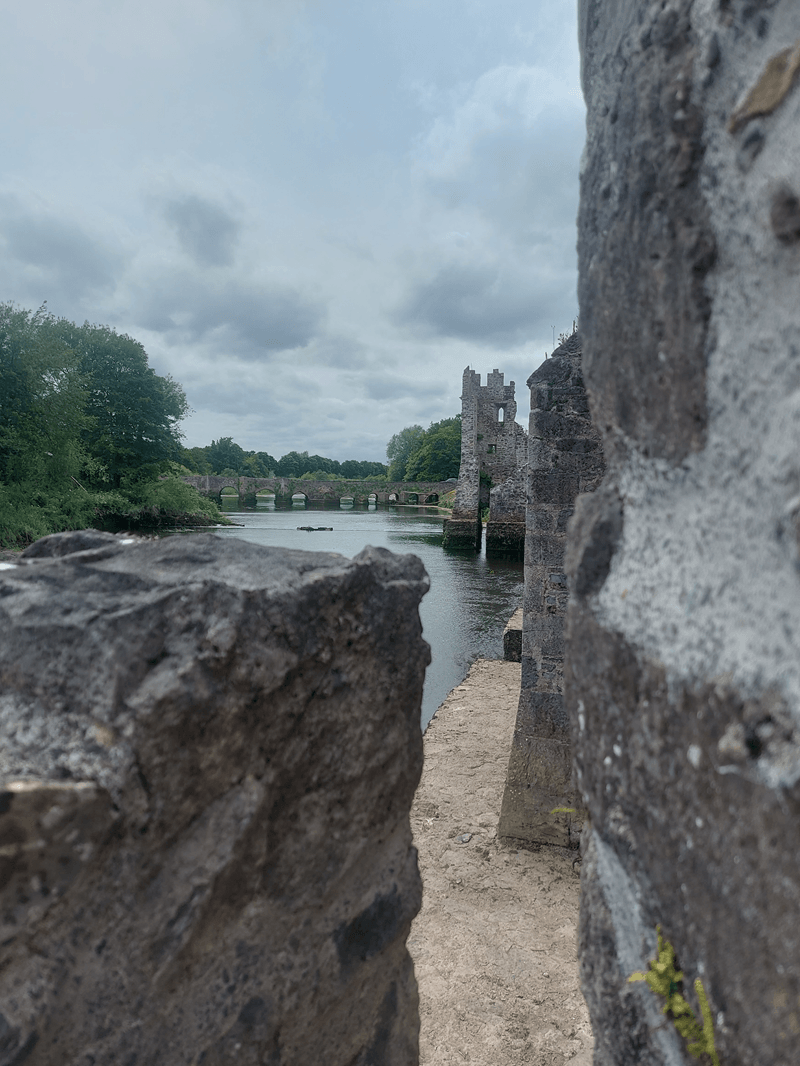
The inner and outer wards were protected by fosses or moats, while the Maigue formed the southern boundary of the complex. Archaeological investigations have shown that water management was an important element of the castle's design [7], [8].
The River Maigue is tidal as far upstream as Adare, and flooding has also presented a continuing conservation challenge. During modern conservation works, archaeological investigation was required along the southern curtain wall, where a bund had been constructed to help protect the castle from flooding [8].
The castle therefore remains closely connected to the river even today, just as it was during the medieval period.
Adare Castle today
Today, Adare Castle is cared for by the Office of Public Works and is one of the most striking medieval monuments in County Limerick. Conservation work has stabilised and preserved substantial portions of the medieval complex [1].
Visitors can still appreciate the basic organisation of the medieval stronghold: the central keep, inner ward, outer ward, curtain walls, gatehouses, halls, defensive fosses and the river frontage [1], [3].
The castle is now visited as a historic monument rather than a military stronghold. Current visitor access is through the Adare Heritage Centre, with guided tours operating during the visitor season [1].
The modern name, Desmond Castle, Adare, reflects its later association with the FitzGerald Earls of Desmond, although its earlier history is equally, and perhaps even more strongly, connected with Geoffrey de Marisco and the FitzGerald Earls of Kildare [2], [9].
Eight centuries of history
Adare Castle is much more than the picturesque ruin that can be seen today.
Its story begins in the early thirteenth century, when Anglo-Norman power was being established in the region and the strategic crossing of the River Maigue was fortified [3].
For centuries it was associated with the powerful FitzGerald Earls of Kildare. The castle was expanded and remodelled, with substantial halls, kitchens, domestic buildings, defensive walls and water defences developing around the original stronghold [2], [8].
The sixteenth century brought political upheaval and rebellion. The fall of the Kildare FitzGeralds transferred the castle into the orbit of the Desmond FitzGeralds, and Adare subsequently became a military stronghold during the Desmond Rebellions and the conflicts of the late sixteenth and early seventeenth centuries [2].
After the violence of the Nine Years' War and the 1641 Rebellion, the castle finally lost its military purpose when it was dismantled by Parliamentary forces in 1657 [1], [2].
Later, the Quin family and the Earls of Dunraven incorporated the ruins into the developing Adare estate, helping to create the remarkable landscape that surrounds the castle today [2], [8].
Modern archaeological investigation has revealed another side of its history: beneath the ruined walls are the remains of kitchens, halls, wells, drains, floors and other features that tell us about the everyday lives of the people who lived and worked here [5], [8].
Standing beside the Maigue, the ruins of Adare Castle therefore represent more than eight centuries of Irish history — from the arrival and consolidation of Anglo-Norman power, through the rise of the great FitzGerald families and the wars of Tudor and Stuart Ireland, to the romantic landscape of the Dunraven estate and the archaeological conservation of the present day.
The castle's walls may have lost their military purpose centuries ago, but their position beside the River Maigue still makes clear why this particular place was chosen in the first place.
References
- [1] Heritage Ireland — Adare Castle
- [2] Limerick Castles Database — Adare Castle, Our Irish Heritage
- [3] Excavations.ie — 2003:1126, Adare Castle, Adare, Co. Limerick
- [4] Excavations.ie — 1975:048, Adare, Co. Limerick
- [5] Excavations.ie — 2002:1072, Adare Castle, Adare, Co. Limerick
- [6] Ireland's Eye — Adare Castle, County Limerick
- [7] Excavations.ie — 2001:742, Adare Castle, Adare, Co. Limerick
- [8] Eachtra Archaeological Projects — Archaeological Excavation Report, Adare Castle, Co. Limerick, 2001–2006
- [9] Office of Public Works — OPW to adopt “Desmond Castle, Adare” as name for famous castle
- [10] Topographical Dictionary of Ireland — Adare, County Limerick, 1837
- [11] Dúchas — The Schools' Collection: Desmonds' Castle, Adare
Other useful links
- Wikipedia, Adare
- Wikipedia, Adare Manor
- Wikipedia, FitzGerald dynasty
- Wikipedia, Earl of Kildare
- Wikipedia, Earl of Desmond
- Wikipedia, Desmond Rebellions
- Wikipedia, Nine Years' War
- Wikipedia, Irish Rebellion of 1641
- Wikipedia, Cromwellian conquest of Ireland
- Wikipedia, Geoffrey de Marisco
- Wikipedia, Domnall Mór Ua Briain
- Wikipedia, Thady Quin
- Wikipedia, Earl of Dunraven and Mount-Earl